Showing posts with label community and the poor. Show all posts

Wednesday, August 17, 2016

All my friends' moms are widows

Danish’s ears perked up to hear the mosque announcement, and he stopped reading.  I usually ignore mosque announcements because, in a basti of close to 10,000 people, they more often than not have nothing to do with my own circle.  But I stopped and listened because Danish wasn’t going to continue his reading until he had heard the announcement.

“Salman the tailor….lives near the recycling area….prayers will be in Daliganj…..Salman the tailor….lives near the recycling area…prayers will be in Daliganj.”

Salman?  Salman is one of my best friends in the basti!  I started to freak out internally and asked Danish what he had just heard.

“Salman, the tailor who lives near the recycling area…”

“Yes, yes, I know Salman, he’s my friend.”

“He died.”

I pick up the books and tell Danish that the lesson is over.  I rush across the basti.  In the five minutes it takes for me to get from one side to the other, I pray over and over, “Let me be confused….let it be some other Salman….let there be some confusion about the message.”  I think of his wife, his three sons, about the various difficulties they’ve been having.  Could it have been a car accident?  Could he have done something to himself?  I am freaking out as I rush across. 

When I got in view of Salman’s home, I saw the red chairs sitting outside, the sure sign of a death in the home.  (There is someone who holds onto a few dozen red chairs to set outside the home for the visiting crowds of guests that precede any funeral.)  But only seconds later, I caught sight of Salman sitting on his steps.  He did not look good, but he was alive.  My heart moved back down out of my throat and I prayed a cautious prayer of thanks that my worst fear hadn’t been realized.  I asked him what was going on.

“My father…you know his health was not good.”

I can see the body lying inside.  Salman, who had just lost his beloved aunt who lives next door to him a month ago, had now lost his father as well.


There’s a conversation that has been stuck in my head a long time, from when a friend of mine who also lived in a slum expressed the vulnerable realization that all of her friends were widows.  Though this friend had a few years on me, she was not yet 50, and many of her friends were even younger.   Yet the various trials and difficulties that befall one here had taken their husbands one at a time.  It is a very difficult thing to be a widow in India, and to be a poor widow is especially difficult.  These women in my friends’ life had a very tough time of things.

With Salman’s father’s death, I realize that the mothers of all my friends are in the same boat.  Saeed, my language helper, lost his father when he was 10 years old and became the man of the house at that point.  Shahmim, my closest friend in the basti and now the primary teacher who works under me, lost his father at the age of 20 while we were living with him.  Haleem, my best friend among my neighbors in the room we’ve now been living in for 2.5 years, lost his father when he was about 13.  Salman, the first friend I made in the basti, is actually much older than all of them were, only a couple years younger than me.  That does not make it an easy thing for him, either.  Now all four of my closest friends in the basti have experienced the loss of their father. 

Salman, at least, had time to grow into being his own man by the time his father passed.  What kind of effect does it have when you lose a father when you’re still half-grown?   Many of the boys had already seen their fathers go through years of illness or inability to be fully present in their lives even before they died.  And what difference does it make in a community when it’s not only you who is without a father, but many of your friends and neighbors as well?

I don’t really know the answers to those questions.  In what feels like many lives ago, my master’s thesis was on the life experiences of students, primarily boys, who appeared to be achieving far below their academic potential.  It wasn’t a very good paper, and I hesitate to draw anything from it at all.  But in spending time in the lives of these boys, the one thing that stuck out the most was that every single one of them had either lost their father or had him absent for significant portions of their childhood.  And that absence appeared to have had a profound and negative effect upon their lives.

I don’t know for sure exactly how all the early deaths of fathers are affecting my community.  But all my friends’ moms are widows.

Tuesday, May 31, 2016

Riot night

The crowd pulsed, a hundred people behind my arms, 20-30 of them trying to push forward with sticks and other weapons.  Opposite us another 15-20 men, some of them also wielding weapons, reached towards the crowd behind me.  Belt blows from the front rained down on my arms and shoulders, and someone’s elbow or fist caught me in the side of the head.

How did we get here?

I had been eating dinner in the dark with my wife and foster daughter when I heard a roar outside.  My first comment was, “That’s not a normal fight.”  I went outside and saw a crowd filling the alleyway outside our home, half of the men unrecognizable to me.  At first it seemed to be a typical yelling argument.  But then I saw signs which indicated that real violence might be possible, so I went down and got ready to intervene.

I soon found that the men I didn’t recognize were from a nearby neighborhood and had come to support one of my neighbor families in the fight.  I couldn’t understand the yelling enough to figure out what the fight was about, but the women living next door to me had instigated it somehow.   There was a good chance there would be yelling and not much more.

Some teenagers I knew made their way in my direction.  Electricity had been out for some time, so I was wearing my headlamp and it attracted their attention.   One wanted to try it on, and got a kick out of shining the light in everyone’s face.  He asked how much it cost – I told him it was expensive and refused to put a number on it.  (Oddly, my headlamp was bought for scientific research in the jungle and is one of the most expensive things I own.)   Minutes later he slipped something into my hand.  They’re brass knuckles, or at least a cheap steel version.  I’m dumbstruck that these kids had come to the argument like they were ready for a gang war.   The brass knuckles didn’t belong to my friend, but to another teenage kid he had taken them from.  

In the dark I casually slipped the weapon into my back pocket and said that I lost it.  The original owner argued for it back, and I told him I’d give it back tomorrow, then switch and say I’ll give it back in an hour.  My friend laughs and calls the kid a “beast”.  The kid appeared to be satisfied with my promise to return it.  I decide I'm gonna hold onto them until I know the moment of violence is passed.

The argument doesn’t seem to get anywhere, but enough people were trying to force the instigators to back off that the energy seemed to be dying.  The outside gang of boys that formed one side backed further and further away until they were almost around the corner.  I decided to get back to dinner, and discreetly slipped the brass knuckles into the kid’s hand and went upstairs.

Ten minutes later, the roar came again.

I rush downstairs and see that people are really at each other.  I work through the mob to try to get to the flash point in the middle.  A couple people trying to hold back the most aggressive instigators have formed a partial division, but the fighters are streaming around them.  I get into the gap and begin to pull/push people back until we create a clear line between the mobs.

If my Hindi was better I might have understood what happened next, but someone said or did something that made the tension escalate.  The crowd pushed behind me and I thought they would push past me for a second, but I was just barely able to hold them back.  Someone pushed me on the chest and I realized that two other guys, shorter than me but very bulky and strong, were also holding the crowd back.  I shouted, “Hey, I’m trying to help you!”, and they realized that we were three.  In that narrow alley, the three of us with our arms out formed a wall that the major instigators in the mob failed to break out of some combination of lack of strength, coordination, or commitment to the fight.  The other mob didn’t have the same kind of coordinated defense, but there were two people who were individually trying to keep the most aggressive men back.

Suddenly there was another rush and the two groups met.  We managed to hold the wall, but now were pushed from the front and the back.  The guys in the mob in front of me had pulled off their belts and randomly-aimed blows struck my arms and shoulders.  Someone behind me from my “own” group hit me in the side of the head with either a fist or an elbow.  But we held, and I yelled at them to back off, and somehow something made the mobs pull back again.

We still had to maintain the wall but I felt a bit of latitude because they weren’t pushing as hard anymore.  I began yelling over the general din at the men in front of me, “You hit me!  You hit me!  Why’d you hit me?  What did I do?”  The sight of a random White foreigner, who clearly wasn’t fighting anyone himself, confronting them in Hindi for having hit him seemed to disarm them.  Several of them apologized, and most began to back off further and form sort of a straggling presence down the alley rather than a grouped mob.

I took the chance to turn and look at my own group, and saw that several still had sticks raised in threat.  One woman who had seemed to be at the center of the issue picked up a brick; I began to move through the crowd towards her and she put the brick down.  I went to her anyway and reached for the stick that she held in her other hand. At first she tried to pull it back from me, then she let me have it.  I dropped the stick in the gutter.

Looking back again towards the mob on the other side, I saw one of them back off to just around the corner, lift up his shirt, and tuck something back into his pants.  I didn’t see what it was at all – it literally could have been anything.  But I have some feeling for what it looks like when a man tucks a gun into his pants.   I kept my eyes on him but he immediately walked away in a different direction from everyone else and disappeared.  The presence of a gun there would be hard for me to believe – I wouldn’t put more of a 20-30% chance that that’s really what I saw.  Yet an hour later after everything had wound down, I began hearing vague talk from neighbors about “the gun” that someone had seen.

Back to the moment, both mobs had backed off to the point that there was now 50-60 feet separating them, with the door to my house directly in the middle.  Besides myself only 3-4 other people walked in this gap between the groups – I don’t know what separated someone who thought they should stay behind the lines from those of us who were willing to walk in the middle, but it was obvious I could do what I wanted.

I wandered over to “my” side, and the tension had dropped enough that people started talking about my role in it.  “You were holding everyone back!”, some of them said, and one teenager began to mime the way in which I’d extended my arms to hold back the crowd.  “You got hit, didn’t you?” several asked, which excited a lot of people, and the extent to which I’d been hit began to dominate the conversation.   One or two of them felt my chest and said, “Your heart is beating hard, isn’t it?  Jon’s heart is beating so hard!”  Meanwhile the tensions decreased and people from both sides began to peel away.  A moment or two before two police officers came around the corner, the opposing mob disappeared entirely.

The police behavior was horrific.  They were intimidating (one officer was at least 4 inches taller and 50 pounds heavier than me, a shockingly big person in these parts), but they intimidated in the manner of tough teenagers, not mature adults.  They yelled at and berated the family who had started the thing as if they were speaking to naughty children.  About the only good thing they did was order the family to stay inside their home and not come out into the alley again for 1 hour.  Overall, though, they reminded me more of how a teenager gang leader might handle a dispute than an officer of the law, and an incompetent gang leader at that.

The police went towards the remnants of “our” crowd that were still there, who excitedly tried to get in complaints about this person or that person from the other side who had done violence.  Then I hear, “They hit the White foreigner too!”

Great.  I’d been wondering if I should disappear when the police showed up, but I wanted to see how they would handle the situation. I really didn’t want their attention.

The police officers were shocked when they heard that from the crowd.  I had stood next to the officers as they berated the family, but perhaps in the dark they hadn’t recognized me as a foreigner.  Or maybe they had seen me but assumed I didn’t live there, or that I hadn’t been involved.  They asked the crowd questions – several of the crowd reiterated how I had been hit.  They turned towards me (I was standing a good 20-30 feet away) and asked if I had been injured.  I shouted out, “No, no, I wasn’t injured, it was nothing.  No, it was nothing,” and made as clear as possible that I was not going to get involved in their complaint.  The officers continued to interrogate the crowd incredulously about me.  They seemed shocked that I lived there, asked what I was doing, got the explanation that I was teaching Hindi reading.  Thankfully, they got enough answers from the crowd that they didn’t come back to me.  They left, and I left.

Back up in my home, my landlord’s family came into our room as a group and berated me.  First they told me I absolutely must not go outside when such fights happened.  I explained that I and two other men had stopped the entire fight, and I would not fail to get involved in such a situation because something really bad could have happened.  They then shifted tones and said that that was okay, but that I needed to disappear once the police came.  This was clearly their real concern.  We talked about the police for ten minutes.  I explained that they had nothing to worry about, that I had my official registration papers that they had helped me to obtain, that I had registered with the local police 2 years earlier, that my visa and registration and lease and everything was all in order.  They still made very, very clear that they didn’t want any involvement with the police, in any way, ever.

This is a common sentiment in the basti.  Almost everyone I know has told me nothing but bad things about the police.  They avoid them at all costs.

I agreed with the family that the police behavior I had seen was not good, and that I would disappear next time and not stick around if the police were around. That seemed to satisfy them, and they’re okay with me getting involved to stop the next fight.

The next day, my involvement in the riot was the talk of the community.  Rumors that I had been injured seemed to have spread across our section of it, and I was asked about my "injuries" by 7-8 people the next day.  One of the most touching interactions was from an old, half-senile man who asked me to sit next to him and then lamented what had happened.  "How could they have hurt someone like you, a nice man who has come here just to teach the children and is doing such good things?"  The second most touching interaction was from a teenager who had been present, who rushed up to me the next day and shouted in an emotion I'd have to call glee, "I listened to you, didn't I?  I respected you, didn't I?  I did what you asked!"

Friday, October 30, 2015

This year's Moharram

Tonight is Moharram, and Rosey’s not feeling well and has already gone to sleep, and the entire slum is awake and engaged, and I feel too much energy in the place to just stay in my room.  So I go out, without much purpose in mind. 

I wander in a big circle around the slum.  A young boy with a bit of a mental problem is excited to see me and says hi.  An acquaintance of mine pulls me over and sits me down in a chair next to a huge caldron of chai on a fire.  He offers me some.  The boy sits across from me.  We make a bit of small talk, I appreciate the hospitality, and I get up again. 

I wander over to the vicinity of a home we used to stay in two years ago.  At a turn in the alley I am undecided about where to go next, and a woman I used to know sees me stall.  “Where are you going?”  “Uh, just wandering….looking at tazias,” I reply.  Tazias are the symbolic crafts that are being displayed on this night.  She says, “Oh, then come over here, there’s a tazia right here!”  She pulls me over in the direction of our old room.  We stop at the tiny gully right next to it, and I see that the tazia isn’t just in the alley or doorway like most of the others, but tucked back into a home I know.  “Go ahead,” she insists.  I reluctantly walk in.


Tucked back behind this tight dirt alleyway is one of the poorest families we’ve ever known.  I walk inside, and indeed a beautiful tazia is set up just inside their home.  The thin paper-and-sticks structure appears only slightly less substantial than the family’s own plastic-and-sticks residence.  A large number of children and a few adult women are sitting in front of it, praying.  They see me and invite me to sit down with them.  I politely excuse myself and try to turn back.  “No, no, I’m sorry, I don’t want to disturb your peace, see you again.”  They insist again, saying, “You must sit, auntie wants to speak to you.”  When I understand what they are saying, I notice that around the corner just out of my view, the matriarch of the family is sitting down.  I can’t deny her, and so I sit down in their midst.

We don’t know her well.  The one time Rose and I visited her home together, she broke down crying as she showed us her incredibly poor residence.  This time the tazia gives her more confidence as a host.  She welcomes me, asks me how I doing, asks where Rosey is and how she is doing.  The other women listen with rapt attention and toss in their questions too.  Many of the children listen to us, while others continue praying their night’s vigil.

I note that this is not going to be a short visit and get used to sitting there.  On one hand I feel uncomfortable to be an outsider in a place of prayer and a man in a place of women and children.  On the other hand, everyone is so peaceful and so incredibly respectful to me that I am put at ease.  One young women in particular engages most actively with me along with the matriarch.  Their questions run the gamat from my religious beliefs to what I cook in my home.  My statement that Rosey cooks the rotis while I cook the veggies elicits laughter and surprise. My statement that I follow Isa the Messiah and that we don't practice the same traditions elicits what appears to be respect.  Most of all, everyone wants to just to get to know me better and treat me well.

When I first sat down the women offered me some sweets that had been prepared specially for that night.  As time draws out, they begin offering me more and more – lentils…chicken curry…more sweets.  I refuse everything the first two times it is offered, but it becomes clear that they won’t be satisfied with my visit unless I have some of everything they have.  The young woman giving me the food, the same one who has been asking me questions, looks so proud of what she has to give and a huge smile never leaves her face.  I eat the treats they lay before me and contemplate, not for the first time, the amazing circumstance of this incredibly poor family in a plastic-and-sticks home in the mud serving and feeding me with all they have to give. 

I have come here to serve the poor, and once again I am struck by how deeply even the very very poor want to serve me.  I feel we’ve shared a sacred space tonight.

Friday, June 12, 2015

One more story

A few years ago I was telling a friend about a suspicious police shooting that I had followed closely in my college years.  The shooting occurred in my college town, at a time when I was heavily involved with the Black community there, and so I kept up-to-date on the details of the case.

Basically, two police officers had shot and killed a young Black man during a traffic stop at night.  One cop claimed the man had pulled a gun and fired at them while they were conducting a search, and they fired on him in self-defense.  There were major issues with their story that made the case suspicious.

* The police rationale for stopping the man was dubious.  They claimed that they stopped him for speeding, but the ticket they wrote out was for "no registration".  However, the car was new and the registration was taped right to the car's window.  Why did they stop him, why did they ask if he was on probation and ask to search him, and why did they write out the ticket when he clearly had registration right there in the window?

* The motive didn't make sense.  The man was 18 years old, had no warrants, no violent record, no gang ties, no history of animosity towards the police.  He was a father returning home at night, had to go to work in the morning.  He had only one spot on his criminal record - a conviction for "carrying a concealed weapon" - brass knuckles in his glove compartment.  Why would he be carrying a gun illegally at night (especially being on probation for the brass knuckles charge), and why would he decide to kill two police officers, who had already run his information and called in the report (the second officer had come specifically as backup for the search)?

* The police officer claimed that the man fired at them first.  However, the gun recovered from the scene had not been fired.  This was the biggest issue with the case...how could the officers claim that the man had fired on them first when the gun recovered from him had not been fired?

* The gun recovered from the victim was a collector's item registered to a retired police chief.  There was no record of it having been sold or stolen.  The gun did not have any fingerprints on it, not even smudges.  This is the second huge red flag.  No one has ever shown how a retired police chief's weapon got into the hands of an 18-year-old Black man.

* Only one officer spoke to investigators.  The other officer pled the 5th and refused to speak.  Why did that officer plead the 5th when the other officer gave a description of events that would have clearly showed no wrongdoing at all?  Why wasn't he willing to give his side of the story to fellow police investigating him?

* There were many other minor points that showed inconsistencies in the "official" version of events.  Among them, an audio recording showed 15 shots fired, but only 14 shots had been fired from the officers' guns and only 14 shell casings were recovered from the scene.  What happened to the mystery shot?  What gun was it fired from? Why did investigators find gunpowder on Irvin Landrum if the gun they had supposedly recovered from him had not fired a shot? The officers' declarations in later testimony differed from their statements directly after the shooting - the officer who fired first changed his statement about whether he had actually seen the gun, changed his statement about who had fired first, and made a claim that the other officer had warned him about the gun when the other officer stated he had never said such a thing.


None of this is a clear smoking gun of manslaughter/murder.  But there are myriad worrisome issues.  No matter what happened, the fact that the officer claimed the man had fired first, when the man's gun had not been fired, is an issue.  No matter what happened, the fact that a gun registered to an officer had ended up on the scene without anyone being able to explain how is an issue.  No matter what happened, the fact that one officer pled the 5th in an officer-involved shooting, but was eventually allowed to return to duty, is an issue.


The behavior by city officials afterwards just added to the anger surrounding the case.  During the aftermath, the following issues emerged.

* Police went to the home of the man's girlfriend (and mother of his two children) to elicit any testimony that could be used as evidence against him.  They did not inform her about the shooting or his death until after they had tried to draw out as much circumstantial evidence against him as they could from her.

* The local sheriff handled the "outside investigation" of the shooting.  Many protesters thought that the local sheriff was too close to the police department to be a truly independent investigator.

* In the initial report, the city said that the gun found had been registered to "a collector", and that it was unknown how it got into the man's possession.  Months later that the city was forced to admit that the "collector" in question was actually a police officer, in fact a former chief.  The city claimed that they had blotted out the police officer's name and failed to disclose his profession because he "wasn't really involved in the case".

* Throughout the case, the city used underhanded methods to taint the credibility of the victim and his family.  They released a report stating that the victim had a previous conviction for "carrying a concealed weapon", without mentioning that the weapon had been brass knuckles, not a gun.  When the man's uncle started leading weekly protests against the city, the city released the uncle's criminal record to newspapers (he had a conviction for armed robbery from back in the 1970s).  That arrest had nothing to do with the case and was  pure retaliation.  The city also hired private investigators to look into the backgrounds of other protesters.

* At the end of the year, the city awarded the two officers with their "Employee of the Year" awards, which included a $1,000 financial prize.  Since the men had not yet returned to duty, the sole action for which they were being rewarded was the shooting of the Black teenager.

* Both officers were eventually allowed to return to duty, even though one officer had pled the 5th and never told his supervisors or the outside investigators what had actually happened.

* The City settled a wrongful death lawsuit with the family for $450,000 without admitting guilt of any kind.


I was well aware of these facts as they occurred, and it upset me a lot.  I stayed focused on the case for more than a year.  However, my focus faded as I moved away from the community.

Until that moment seven years later when I looked up the case for a friend.  I looked up an article about the shooting for him and saw the names of the officers.  And then I realized that one of the involved officers had become a friend of mine.

I hadn't known the officer when I was following the case and am generally bad with names, so his name had hadn't stuck with me.  When I first met him a couple years later, I didn't make the connection.  I knew this new friend had been a police officer, and that he had recently left the force, but we never talked about his previous job.  He was a soft-spoken, polite, kind guy, who looked up to me in a sense and constantly praised the things I was doing in my life.  He was the kind of person you have a hard time imagining as a police officer, figuring that he must have focused on community relations or something.  You couldn't imagine him using force of any kind.  Over the next five years as we got to know each other and our friendship grew, his time on the police force just didn't come up.

So I sat there stunned, seeing his name on the computer screen.  This was the first major police case I'd ever known about, my prototype of a suspicious police shooting.  And my nice, soft-spoken, kind-hearted friend was the man who had fired first.

My mind spun.  I didn't know what to think.  I couldn't believe that I'd never heard about it, never been told about it.  From carefully talking around the issue with a number of mutual friends, I found that none of them had known about it either. As far as I could tell, no one at church had ever spoken about it in any context.  How did this stay such a big secret?  Could my police officer friend tell me what really happened?  Did the fact that a guy like him had been involved make me want to rethink the case?  I spent my time reading through all the evidence, all the reports, all the protester arguments against the official reports.  I did that at least three times without getting clarity.


Some friends who have read my accounts have felt that I've been overly focused on the side of the victim.  They feel that I have not given the police officers a fair hearing.  And it is certainly true that it is the victims' side of the story that I have wanted to tell.  But I have known a lot of officers in a number of contexts, and it adds a humanity and uncertainty to how I view many of these cases.  As I said earlier, a close relative of mine was a career officer.  Two friends from childhood became officers.  I got to know one former officer quite well as we went to graduate school together, another from church, and partnered with several others in various work capacities through the schools I taught at and a charity I was involved in.  Most intensely, I spent a year working in a jail side-by-side with sheriff's deputies five days a week.

Knowing officers had added depth to my thoughts about these cases.  That can go both ways.  It can make me wonder whether soft-hearted people I know could be capable of malicious intent.  But I've also been able to hear good cops tell me first-hand stories of why they had beaten suspects who didn't need to be beaten, solely due to the stress that they had been under.  The more I've learned about how many modern police forces operate and been able to meet the people who have been working under them, the more I've been able to believe that good people, even cops, can be capable of some really bad things.


This is my last post in this series.  I wanted to share my own context for these issues because the cause is both personal and global to me.  Today's news stories are about the recent tragedies of Tamir Rice, Walter Scott, Freddy Gray, John Crawford III, Eric Courtney Harris, Anthony Hill, Eric Garner, Sureshbhai Patel, William Chapman, Kajiemi Powell, Akai Gurley, Yvette Smith, Timothy Russell, Melissa Williams, Michael Brown, Antonio Zambrano-Montes, Charly "Africa" Leundeu Keunang, Rumain Brisbon, and dozens of others just in this past year.  They're also about those who faced the things back before it became the public issue - Kalief Browder, Darren Rainey, Karil Denyakin, Amadou Diallo, Sean Bell, Trent Benefield, Joseph Guzman, Robbie Tolan, Leroy Grant, Rayshawn Brown, Danny Reyes, Oscar Grant, Alexandra Torrensvilas, Douglas Dendinger, Jonathan Ferrell, Larry Jackson, Reynaldo Cuevas, Rekia Boyd, Wendell Allen, and hundreds of others.  But it's also about the thousands of incidents every single day that never get reported, and the regular people we interact with in our daily lives who never make the news.

I also wanted to share my personal experience because 95% of what I've experienced has occurred during the short period in my life in which I was deeply involved with the Black community.  Those who condemn the citizens of Ferguson without having read the whole report, who critique the riots in Baltimore without knowing the history between police and residents there, who watch video of teens running in McKinney without knowing what segregation has meant in that town's recent history - or even the positive connotations it holds for some White people there today, do so without a real understanding of the difference between interacting with police from a privileged perspective and interacting with police as a Black person in a Black community.

Illicit police-citizen conflict is not merely a racial issue.  The victims and perpetrators both can come from any racial background.  But due to the manner in which Black communities are policed, it is an issue that far and away disproportionately affects the Black population.  And that has negative repercussions that extend far beyond the immediate victims themselves.  Poor policing discourages a community, prevents citizens from seeking the police for help, exacerbates crime.  Fathers and mothers and caretakers who are unjustly shot or unjustly imprisoned leave orphans back in their communities, leading to more crime, leading to more death and imprisonment, and feeding into a cycle that only gets worse.

A look at the comments section on any mainstream or conservative media source will reveal hundreds of comments of the type, "But look at how many Black people are in jail!  Look at how many minorities are arrested!  When are we going to accept that it's all their fault!"

Until we've addressed the real systematic issues that have led to those communities being where they are today, and that help contribute to so many people from those communities ending up dead or in jail, we haven't accepted that it is indeed partially our own fault.

Saturday, June 06, 2015

Race matters

My roommate Ian walked out our front door into South Central.  He was an Americorps volunteer, wearing a t-shirt and jeans and carrying nothing.

The police car pulled up as he was walking across our front lawn.  "Get on the ground!"

Ian looked at the officer incredulously and started to get down.  He questioned what was going on since he hadn't done anything.

"We saw you throw something on the ground.  Get down!"

Ian laid down on the ground on his stomach.  The police came over, handcuffed him, and searched him.  "What did you throw down?"

Ian replied, "I didn't throw anything down.  I didn't have anything in my hand at all."

After failing to find anything, the police questioned what he was doing in the area, then uncuffed and released him.

Ian wasn't carrying anything, wasn't doing anything suspicious, was walking on his own front lawn.  Do police ever handcuff you when you're just walking in your front yard?  I have little doubt that the police harassed Ian because he was White, and he was a neighborhood where they didn't expect to see White people.


Two years earlier, I had walked out of my home in Inglewood to drive to the store.  As I left my house I saw a police car approaching.  My immediate thought was, "Great, now they're probably going to hassle me."  I buckled my seatbelt before starting the car, pulled out carefully, followed the traffic laws to a T.  It didn't matter.  One block away the cop car turned its lights on and pulled me over.

I tried to speak to the officer when he came up to my door, but didn't get the chance.  Before I could say anything, he yelled at me, "Get out of the car."

I opened the door to get out, and once the door opened he reached in and pulled me out by the arm.  He put me up against the side of the car and searched me.  The other officer who was with him asked if he could search the car, and I let him, since I obviously had nothing there.

"Where are you from?" the officer who had searched me asked.

"You saw me," I told him.  "That apartment I just walked out of."

"No, where are you from," he demanded.

"That is my home, that's where I live," I replied defiantly, with emphasis.

"What do you do?" the officer asked with more hesitation.

"I'm a school teacher.  I teach at a school right here," I threw in his face.

"You fit the description of someone we were looking for," the officers claimed as they let me go.

"Yeah, right, I'm sure you're getting all sorts of calls about nicely dressed 6'1" young White men in the heart of Inglewood today," I thought as I continued on to my destination.  Once again, I'm certain that I was stopped not because of any actual evidence of wrongdoing, but because the color of my skin didn't fit who they thought should be around that neighborhood.


Those aren't the only stories like that.  In another neighborhood in inner LA I was stopped twice while walking on the sidewalk, told to hold my arms above my head and spread my legs out, and searched right there on the street.  The policeman was almost shocked when I told him I was an Inglewood resident.  "Really?" I still remember him asking incredulously.  "Really?" he repeated.

Racial profiling is illegal.  It violates the Constitution's guarantees of equal protection under the law.  It violates the Constitution's protection against unreasonable search and seizure.  It pisses people off.  It alienates entire communities from the police.  And yet it keeps happening all the time.

Now, when I tell stories of White people getting profiled in Black neighborhoods, the story sounds a little funny.  It isn't the biggest inconvenience in the world.  But that's because I, as a White man, am only racially profiled when I'm in Black neighborhoods, a place White people rarely tread.  Black people, on the other hand, are racially profiled in their own Black neighborhoods AND in White neighborhoods, in middle-class suburbs and wealthy business districts, on the roads, on the sidewalks, and in front of their own schools.  That's their experience nearly everywhere they go.


It's the experience of Los Angeles film producer Charles Belk, arrested in Beverly Hills and detained by police for 6 hours because he "matched the description" of a robbery, despite having an obvious alibi and not looking anything like the actual robber, whose face was recorded on video.  New York City college student Trayvon Christian, detained by police because he had bought a belt at Barney's.  Aspiring music video producer Joshua Rivers, who had $16,000 stolen from him by DEA agents and his dreams ruined because he "fit the profile" of a drug trafficker.  Yale college student Charles Blow, held up at gunpoint because he "fit the description" of a suspect.   Harvard University scholar Henry Louis Gates Jr., reported to police by neighbors for getting into his own home and then arrested inside for supposedly "disturbing the peace" when questioning the officer.  Retired Major League Baseball player Doug Blanville, told by an officer to explain his presence in his own driveway in Hartford.  Current NBA player Thabo Sefolosha, who was followed by police, knocked to the ground, and had his leg broken when he was on the sidewalk after police officers responded to an unrelated stabbing at a club.  New Guinean immigrant Amadou Dillo, shot 41 times by police after an unexplained stop because police thought his wallet was a gun. Former Hall of Fame Laker and businessman Jamaal Wilkes, stopped and handcuffed by police while driving his Trans Am because his license tag was "about to expire".  University of Wisconsin law professor Calvin Warren, stopped and questioned by campus police because he had a goatee.  And on and on and on, hundreds of thousands or possibly millions of people across America.

It's the experience of the Black people of Ferguson and the Black and Latino people of New York City and the Black people in Iowa and minorities in possibly every state in America.

And we wonder why Black people in many communities don't trust the police.  We wonder why, when seeing the universal issues of excessive force and constitutional violations and other problems that I've detailed in previous entries, the pain seems to fall primarily on people of color.


I want to tell one more story that is very personal for me.  One day I was sitting at the kitchen table with an intimate family member, whose husband had been a career officer and the chief of police for a small California town.  The conversation turned to her late husband, and for some reason she started talking about the negative relationship he had had with a Black resident in the town.  "That guy Leroy was always causing trouble, always accusing us of racism.  But we weren't racist towards Black people.  We were racist towards Mexicans though.  They were dirty, always hanging around not doing any work."

I listened stunned, stunned that he had been a racist police chief and stunned that she had admitted it.  I wonder how many other times these conversations happen at family dinner tables around America, how many other times the secrets heard are kept in silence, how many people have suffered due to the racial suspicions of those who operate with the force of law.

I wonder how much longer it will go on, and what it will take to change.

Monday, May 11, 2015

Just a little too much

During the years I lived in Inglewood, I got little glimpses of the community-police dynamic.  It was not pretty.

One of the first memories of my time there was when I walked home from school to get lunch at my apartment.  While I was sitting at my computer eating a burrito, a major police action occurred across the street.  Apparently some robbers had ran from police and were in hiding.  The police surrounded the block, a guy with a shotgun standing every 40 feet or so.  I was amazed.  Police cars rolling around, guns being brandished everywhere, helicopters overhead.  I had never seen anything like it.

The shotguns looked like they were just being used as tools of intimidation.  Which, of course, they were.


Massive displays of force like that were common.  I had students tell me stories of their homes getting raided, police breaking down doors, charging in with guns drawn, scaring their family.  Sometimes it was the case of mistaken identity, or the police claimed they had the right home but failed to find anything in it.

Once it happened to me.  I went to my school on a Saturday, as I did every week, to water the class garden and take care of the classroom animals.  Since I only had my classroom key and not a front gate key, I jumped the gate like I did every week (which my principal was well aware of).  Except this week someone called the cops.

I didn't know anything was happening until I saw multiple police cars pull up into the school's back parking lot.  I thought, "Whoa, must be something big going on across the street."  Then I saw the police get out of their car and start gesturing towards me.  Wait, no, they were gesturing behind me.  I turned around and saw that multiple police cars had pulled into the front parking lot, and a gang of police officers had their guns drawn.

I walked over to them.

They asked me what I was doing.

I said that I was a teacher watering the plants.  I showed them the water can I was holding in my hand.

They put the guns away, apologized, blamed the caller, left.

(I should note that I got off a lot easier than the four Black parole officers who had guns pulled on them in a similar error.)

Our neighborhood was a scary place.  I knew multiple kids who got shot - it seemed to happen to someone at our school about once a year.  Once I drove down the street with one of my kids in the car, and he pointed out homes where friends of his had died, places where people he had known had been shot.  There was a shooting in front of our own house at least 4, possibly 5 times in the 4.5 years I lived there.

But I never saw how the dramatically violent police presence made the neighborhood safer, or reduced the likelihood that someone would die a violent death.  In fact, I think it made the neighborhood more dangerous.  And it wasn't just the people who were shot by Inglewood PD that I'm referring to here.  For everyone in Inglewood, the police were scary.  It made things tense.  It made people not want to call police in dangerous situations, not knowing what might happen.  And subconsciously it confirmed the belief that violence and force were the proper arbitrators of dispute, the go-to means of asserting one's own rights and power.

In America, I generally don't believe that we live in a "police state".  But some of our poorest neighborhoods are living in something close to one, and a lot of other neighborhoods have been moving in that direction in recent years.  Military gear, even armored vehicles, have been flowing into communities.  Images of police officers pointing sniper rifles at unarmed civilians or yelling threats at protesters, (even murderous ones) are the new normal.

Do neighborhoods with militarized police forces breed calmer, safer, more peace-loving citizens?  Does intimidation work as a technique for improving the life of a community?  I really doubt it.  But it appears to be the road that many community police forces have chosen to walk right now.  We only need to look at neighborhoods like Inglewood and others like it to see how well it's been working so far.

Friday, April 24, 2015

Beaten Community

The year after my jaywalking experiment, I moved to Inglewood to take a job teaching young people.  I entered a community that was riled up.

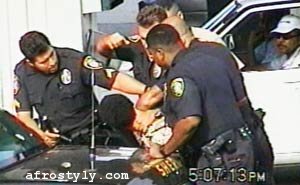
The month before I moved in, at a gas station just down the street, a man had videotaped a police officer beating up a teenage boy in handcuffs.

The videotape shows an officer picking up the boy from behind, who appears limp, and then slamming him against the hood of his patrol car.  He then turns the boy around and punches the boy in the face with a closed fist.

The boy was Donovan Jackson, a special-education student at the local high school.  He had been diagnosed with an auditory processing delay, which meant that it was difficult for him to follow verbal instructions.

Donovan had ridden to the gas station with his dad, then went inside the station to buy a bag of chips.   Police officer Carlos Lopez saw that the parked car's license plate tags were expired and approached Donovan's father, where he proceeded to find that his driver's license was suspended.  Officer Lopez was arresting Donovan's father when Donovan returned with his chips.  (Donovan's father, who was never accused of resisting, suffered injured ribs in the arrest.)

Officer Lopez yelled instructions at Donovan, who didn't respond and just stood in place looking at his father being arrested.  The officer finished arresting Donovan's dad and then attempted to force Donovan into the police car.  Officer Lopez claims that Donovan swung at him.  Two more officers arrived at this moment, having been called by Officer Lopez to provide backup to the arrest.  These officers, Jeremy Morse and Bijan Darvish, grabbed Donovan by the arms and forced him to the ground.  As he fell to the ground, Donovan, who was much smaller than the officers arresting him, flailed his arms, grabbing at Officer Morse's shirt and leaving a scratch on his face.  Officer Davish claims that Donovan also grabbed his uniform.  Officer Darvish then punched Donovan twice in the face.  Two more officers arrived at the scene (5 officers total now for a suspended licence!), one of them, Officer Antoine Crook, hitting Donovan with a flashlight in the process, and they handcuffed the teenager.  Donovan claims that the officers dragged him around the ground by the chain he wore on his neck, and that he was unable to breathe and nearly unconscious by the time he was handcuffed.

Several observers were screaming at the police to stop beating the teenager, which attracted a crowd.  One of them, Mitchell Crooks, heard the noise and grabbed a camcorder to began videotaping the beating he was observing.  At the start of the videotape, you can see Officer Morse pull the handcuffed Donovan up to his feet, who is not moving and appears limp, and then slam him face-first against the hood of his police car.


Officer Morse claims that at this point Donovan grabs his testicles, though that is not apparent on the video tape.  Officer Morse then held Donovan's neck with his left hand and punched Donovan in the face with his right hand.  He then appears to start choking Donovan, at which point the other officers intervene, one of them physically pulling Officer Morse off of Donovan.


It turned out that this was not an isolated incident.  A local woman claimed that Officer Morse had assaulted her earlier in the year.  The LA Times reported more than a dozen abuse-of-force incidents that the Inglewood Police Department had been involved in in recent years, often resulting in broken noses and teeth getting knocked out.  Many of the cases involved people who had not committed any crime, but were accused of police of "interfering with police business" or "contempt of cop".  Several of the people beaten by Inglewood police officers were local schoolteachers.

Officer Morse, who was videotaped slamming the handcuffed Donovan against the car and punching him in the face, was fired.

Officer Darvish, Morse's partner who later admitted punching Donovan in the face twice (not on tape), was suspended 10 days for filing a false incident report which failed to acknowledge any of the beating.  He continued to work as an officer in good standing with the Inglewood PD.

Officer Crook, who admitted hitting Donovan with a flashlight (not on tape), was suspended 4 days and lost his job as an officer, being reassigned as a civilian jailer.

Mitchell Crooks, the man who videotaped the incident, was tracked down by police and arrested a week later by officers on a 3-year-old warrant for misdemeanor DUI and hit-and-run.  Though he had previously been stopped by police several times for jaywalking and traffic violations, this was the first time that he was arrested, extradited back to Placer County, and forced to face charges.


When the courts got involved, it really got interesting.

Officer Morse, represented by elite lawyers who moved the trial to Torrance (a middle-class community miles from Inglewood) and whittled down the jury pool down to a single Black juror, managed to get a hung jury (7 in favor of conviction, 5 against) in his criminal trial.  Officer Morse was never convicted of any crime, despite the clear video evidence and testimony of other officers.  In a civil case, Officer Morse sued the City of Inglewood for firing him and claimed anti-White racial discrimination, because Officer Crook wasn't fired.  He won his lawsuit and was awarded $1.6 million.

Officer Darvish was found not guilty of filing a false report.  He also sued the city, like Officer Morse claiming that his 10-day suspension was the result of anti-White racial discrimination.  He also won and was awarded $810,000.  He still works as an officer.

Officer Crook and one other officer were granted immunity for their grand jury testimony against Officer Morse.

Donovan Jackson's family sued the City of Inglewood and the Inglewood PD in Federal Court for violations of Donovan's civil rights.  They settled out-of-court for an undisclosed amount.

Mitchell Crooks, the witness who videotaped the beating, served 7 months in jail for his arrest on the unrelated charges.

The City of Inglewood later sued its own lawyers for losing so many cases so badly.


This was the Inglewood neighborhood that I walked into.  From this high-profile case, citizens learned (or had confirmed), that:

* The police, who had been beating them for years, could continue to get away with it even if they got caught on videotape.

* Police officers are privileged enough that even when doing something wrong, they can still come out on top.

* Doing the right thing and going to the police with evidence might not be in your own best interest.

* The City of Inglewood is completely incompetent in all matters.


The problems with police brutality in Inglewood did not end.  In 2008, the LA Times published yet another report on excessive force by the Inglewood PD, including 11 lethal killings of citizens in 5 years, half of which were unarmed.  One especially egregious case involved a mentally ill man who repeatedly asked officers if he could pull up his slipping pants, then was shot and killed when he reached to pull them up.   Another involved a man shot in the back who had run away when officers stopped him for riding his bike on the sidewalk.  In 2010, the US Justice Department found significant flaws in how the Inglewood PD handled use-of-force incidents.  Unfortunately, excessive force in the Inglewood PD continues to this day.

Wednesday, April 22, 2015

Jaywalking for the police

I'm guessing that many people have noticed me talking about police-community relations during the past year.  (Though not on this blog.  Until now.)

This is not a new topic for me, but something that I've been thinking about for the last 15+ years.  So I wanted to share a few of my own experiences.

Growing up White, I didn't think particularly much about the police.  My grandfather was a California Highway Patrolman and later the chief of police of two small towns.  I had several friends whose fathers were cops.  But our town was rural and very quiet, and I never interacted with police officers in any official capacity.

In college I moved to a big city, learned more US History, and started to get a more diverse range of inputs on the impact that policing had on daily life for various communities.  At a Christian conference I attended during my senior year, I heard stories about the disproportionate manner in which Black people were often treated by police in comparison with White people.  But since very few people in my college were Black and most of my own police experiences were simply local cops coming to parties in response to noise complaints, I never got involved with anything myself.

This changed the summer after I graduated from college.  I started graduate school and my first professor was an African-American woman who had recently moved to town from a nearby city.  She was a Ph.D and an author, had been an award-winning teacher for many years, and was a professional in every sense.  In fact, I learned more about teaching from that first class with her than I did in all my later classes combined, and to this day I would say that she was my all-time favorite professor.  (I also took my final graduate school class with her.)  But she had one story that had nothing to do with teaching that stuck out to me.

About halfway through the summer, our professor came to class in a perturbed mood.  She complained that her son had just received his second jaywalking ticket since they had moved to town.  Both tickets had been given in "The Village", a heavy-commerce part of town with a walking culture, where cars moved slowly and people frequently crossed the street wherever they wanted.

That shocked me.  I had lived in this town for four years, and had never received a jaywalking ticket even though I jaywalked all the time.  I couldn't recall any of the other college students I knew receiving a jaywalking ticket.  But this 17-year-old Black teenager had already picked up two jaywalking tickets in his first couple of months?

There had been rumors that our mostly-White, middle-class college town had some racial animosity towards Black people.  A major police incident involving a young Black man had occured two years earlier, and there was an idea that racial animosity was particularly prevalent among city officials and the police.  There were strong suspicions of systematic racial profiling, but the local police department had refused to take racial statistics on officer stops.  Until now it hadn't affected anyone I knew.

So I decided to run a test.  I would purposely jaywalk across the biggest, busiest road in town at least 6 times every day for 6 months.  I would make a concerted effort to violate the jaywalking laws as often as possible, to see if a 21-year-old White man could possibly pick up the same tickets that a 17-year-old Black man had picked up.

I embarked on this experiment, not fearing the consequences, because I was almost certain that I already knew what would happen.

Sure enough, six months and approximately 1500 jaywalking incidents later, I was still ticketless.  I had jaywalked every day as often as I could without any policeman ever choosing to pull me over.  I'm not certain how many times a cop saw me jaywalk, but there were 7 incidents where I "illegally" stepped out onto the road directly in front of an officer's car.  In one incident the officer had to hit the brakes to avoid me.  Yet not once did any officer even stop to talk to me or give me a warning.  My jaywalking simply wasn't relevant to their police duties.

I reached the six month mark of my experiment confident that some laws didn't apply to me the same way they applied to other people.  It wasn't a perfect experiment.  I am certain that White people occasionally get ticketed for jaywalking in our community.  But it seemed too much of a coincidence that one of the very few Black men I knew would get 2 tickets within a couple months of moving into the community, while I couldn't get a ticket in 6 months no matter how hard I tried to keep violating the same rules in the most outlandish manner.  To this point in my life I have still never, ever been ticketed for jaywalking, despite the fact that I do a rather poor job of obeying the law in this regard.

The experiment stuck with me, and I as moved to a new community the next year, I experienced disparity in police treatment in a new environment.


Wednesday, May 28, 2014

The Great Divide

I recently attended a talk in the fanciest-looking building in our city.

The speaker was someone I've recently been helping out with a project, and so she had me come up to share a bit. The audience consisted of a few dozen powerful businessmen. (Luckily, I had changed into the best clothes I own right before I came.) A videographer and three photographers rolled film while I spoke. The next day articles about the talk would appear in a dozen newspapers in three languages, with two or three of them mentioning “Mister John”.

After the talk I was pulled aside by half-a-dozen wealthy men in turn, all of whom wanted to ask me questions and exchange contact information. I finally got out of there almost three hours after the meeting began.

While others got into their chauffeured cars, I walked out of the building, crossed one street, ducked under the railroad tracks, and entered my slum, not 5 minutes from where I'd just hobnobbed with the rich and powerful. As I strolled through the alleys I felt like my clothes didn't attach to my body. There was a tangible electricity on my skin, as I thought, “Where was I? And now where am I? And what could all those who I was just talking to know about the lives that are lived right here?”  It felt like I had just escaped back into real life from something less than that.  Later that week I told my friends that it was the moment in the week that I felt the most alive.


America has used multinational corporations, the military, and remarkably unjust trade and aid laws in order to outsource its poverty to other countries where it doesn't have to look at it. But here, the incredibly rich and incredibly poor still live within sight of each other. And yet they feel almost as far apart.   

Saturday, May 24, 2014

The most surreal movie experience of my life

A chai-wala delivers drinks to working men.

A teenager cracks jokes with his uncle in an auto shop.

A shirtless boy tries to sell flowers on the streets.

A kid focuses on the embroidery he sets into place.

A ragpicker gets chased away from pieces of trash too close to the VIPs.

The scenes crawled across the screen. The camera lingered on boys trying to help their families (or just themselves) survive in the richest city in India, as wealthy businessmen and private school kids zipped by in the background. The empathy with which the children were depicted was stunning.


Last night I saw “Hawaa Hawaai”, a Bollywood movie about a child laborer from an Indian slum who pursues his dreams while trying to deal with serious illness and his father's death. I went to the movie together with my friend Mohammed...who for most of his life has been a child laborer from an Indian slum pursuing his dreams while trying to deal with serious illness and his father's death.

Neither of us knew what the movie was going to be about when we went to watch it, and we sort of picked it on a whim. Mohammed was treating me to the movie and not only bought my ticket, but insisted on getting me a cold drink.

It was a comfortable, nice movie theater. As I was moved by the film's scene-setting, it took conscious effort to focus on the fact that Mohammed wasn't just any friend laughing at the jokes, but someone who had lived much of it. I don't know what it meant for my experience watching the movie. If the characters in the movie had been portrayed unnaturally or offensively, I'm sure it would have meant something. But considering the compassion and empathy with which the characters were depicted...I was happy to be there with Mohammed, and that was that.

I asked him the next day if he liked the movie, and he said that he did. I asked him what he liked most about the movie. The assumed answer was going to be “the jokes”, since Mohammed had laughed so hard at a number of them. But instead, he answered, “His hard work.”


There's a bit of Bollywood in the movie, but it is very much worth watching.

Wednesday, May 21, 2014

Those Hindus

My 21-year-old Muslim friend came up to me and told me that he had two interactions from this morning to tell me about. In his words:

“This morning my brother told me that Hindus are bad people. I asked him, 'Who made Hindus?' God did! We are all children of God, so we cannot say that they are bad.”

“Then an aunti told me today, 'Don't eat the poori from the Hindus because they drink alcohol.' [That day was a Hindu festival and some Hindus were distributing free food.] I told her, 'Many Muslims in our basti drink too! Have you ever eaten in my home?' She said, 'Yes, twice.' So I told her, 'Well, I have drunk alcohol twice!'”


Yeast spreads slowly, and the early steps don't look like much. But eventually it permeates the whole dough.

Monday, September 30, 2013

A day in the life of a 10-year-old child laborer

7am: School starts. Wake up as late as possible to wash your face, throw on your uniform, pack your snack, and get all your books and notebooks together. Doing these tasks inappropriately may lead to getting a beating at school.

1pm: School ends. You were nodding off a lot of the time anyway. Rush home for lunch and a tiny rest.

1:30pm: Arabic and Urdu lessons at the mosque start. Here you gain a religious education and the basics of 2 more languages to add to the Hindi and English you're learning at school.

5pm: Lessons at the mosque end. Go directly to the screen-printing shop, where a stable of young boys keeps the operation going.

7pm: Leave the screen-printing shop for your job assisting the local slum medical dispensary.

11pm: Shift at the dispensary finishes. For the 4 hours a day you give there, you receive 300 rupees (about $5) a month.  $5 a month.  You head right back to the screen-printing shop.

3am: Shift at the screen-printing shop finishes. For the 6 hours a day you give there, you will receive 50 rupees (about $1) a week. This wage holds for your first 3 years, which is your “apprenticeship”. (You actually learned the entire job in the first week.)

At the age of 10, you are earning almost $10/month for your family by working 10 hours a day. That works out to an hourly wage of a little more than 3 cents.


Age 13

After 3 years of this, you will quit school so you can work at the screen-printing shop 13 hours a day. Your apprenticeship ends and your pay as a screen-printer jumps to $1.50/day. Combined with a minor raise at the dispensary, you are now earning about $55 a month for your family. With 17 hours of work per day, that works out to almost 10 cents an hour. Due to the death of your father 3 years earlier, you are the primary breadwinner in your family.


Age 15

After several years, the dispensary pay climbs to $12/month, and the screen-printing shop slowly raises your wages until they reach $2.50 a day. Now you are earning $85/month, or about 17 cents an hour.


Age 16

At this age you are able to find more legitimate work at a local mall that pays $3.50/day for 10+ hours, 6 days a week. You now earn over 30 cents an hour, a wage that won't get you out of the slum but at least seems within the bounds of human decency. However, you will never get the chance to repeat the missed years of school. You will never make up for the childhood play that you lost. You may never recover from the health problems you picked up from sitting/standing/working for 18-20 hours a day during your growing years. And your family won't be any closer to ending the cycle of poverty that forced you into your child labor career in the first place.


This is not the story of every child laborer. Many do much easier work, for fewer hours. Others do much harder work for just as many hours. Not all have to start by age 10. Some start as early as 2 or 3. (As hard as that is to believe, yes, you can pick up trash and you can beg as early as age 2 or 3.) Obviously not everyone loses a father, but a surprisingly large number of people under these conditions lose their father or some other family member at an early age. Some children get paid a little more than this. Many get paid even less. Some are able to continue going to school. Many never go to school at all. And some eventually are able to work their way into even better jobs, where they can reasonably support a family outside the slum without their own kids having to work. But many will be stuck in the very same jobs they did as children for the rest of their lives, as will their own children.


There is nothing in our basti that bothers me as often as the cycle of child labor that I see on a daily basis. Lord, be with those kids. Lord, help me to find some way to address the issue and work together with them towards a more fulfilling life.

Tuesday, September 24, 2013

The same fever is not the same fever

Three weeks ago I had a fever. I started getting headaches, my skin was achy, I became very tired, and a crazy red rash spread all over my body from head to toe. It might have been a mild case of Dengue Fever, or it could have been any number of other viral infections. A little more than a week after the first symptoms, I was fine.

It wasn't until I got better that I realized how many other people in the slum were sick. My good friend's baby had a fever. So did his aunt. So did my language helper. All five people in the family we ate the feast with were sick. So were four members in another family we knew. So were all sorts of other people in the basti – one here, one there. Rose, gratefully, never got sick, nor did our landlord or their family, but almost everyone else we knew seemed to have at least one family member go down.

It was in the midst of this little epidemic that I realized how different my experience still is from the experience of my neighbors. For me, getting the funny rash/fever was a little bit of an adventure. I enjoyed trying to figure out what I had. I was somewhat uncomfortable, but not horribly so. I had to take it easy for a few days, but I don't have a lot of responsibilities anyway. When I went to endure a 2.5 hour liturgy near the tail end of the illness (at a church we have to walk 2 miles to get to), I made it a little bit of a personal contest to see if I could continue to stand up without passing out. I observed my symptoms closely, and was ready to go to a doctor the moment that anything extraordinary happened, but nothing occurred that forced me to take the fever very seriously.

It is not that way for my neighbors. For them, even the “mild” fever hits their health hard. They don't have the background of good rest and nutrition and exercise and easy living that I have, and so their bodies have far less leeway. They are really wiped out when a virus makes their body work that much harder. The adults get less work done. The kids miss school, some more than a week. Death is a real possibility for babies and young children and the elderly and those whose bodies are already wracked by other thing. In families where multiple members are sick, a lot of the normal life stops.

And these little epidemics are something that happens a lot in the basti.

I am reminded that no matter where I choose to live, or how I choose to live, for me it is a choice. I wasn't forced into this life, and I could leave it whenever I want. And no matter what possessions or connections I give up, I haven't given up my education, my stable and healthy upbringing, my foreign passport, my medical insurance, or my access via friends and family to as much money as I would ever need (no matter how little might be in my own bank account).

I hope, through this life, to know the poor better. I hope to have solidarity with them in some way, to understand their hopes and fears to a deeper degree than I could if I didn't live with them, to be able to form a community together that will benefit both of us.


But I am reminded that as much as I have solidarity with them, I will never be them. And because of that, they keep having to suffer in ways that I don't, even when we share the same fever.

Friday, July 19, 2013

Basti Women and the po-po

Forty-five people came together from our slum to attend the protest. Over 40 of them were women, nearly half of those girls. Muslim, Hindu, Christian, in saris and salwars and burkas, from elementary school girls to the elderly, the whole spectrum was represented. They gathered in the city center, joined by 50-60 more women from other slums and a few middle-class NGO workers, and got ready to march on the police in protest over their negligence in a string of horrific rape cases in our city and across the country.

Before they even started marching, the most intense rainstorm of the year hit. Clothes and signs were drenched. The street filled in with deep puddles. But right in the middle of the heaviest rain, the women began their march.

They shouted slogans, held signs and banners, and blocked the street as they marched through them. Within twenty minutes, the police realized what was happening and freaked out. They ran ahead of the marchers and attempted to blockade the entire road just to prevent the marchers from reaching the central government buildings for the state.

Those police officers were a foot away from putting the last metal gate barrier in place when the women reached them. It was no match. The women grabbed the barrier and drove back the police, four officers stumbling backwards under the weight of the crowd. A second heavy barrier segment went crashing to the ground right next to me as the women hit it, and the throng surged through. The police retreated to headquarters as quickly as they could for reinforcements.

As the marchers approached the Parliament building, cameras appeared everywhere. A television crew waited at the gates of the building. When the women reached the gates, 40-50 officers were waiting there for them. The military were also called in...for what? Because the police were afraid of the women? Because they wanted to intimidate the women? Soon law-enforcement/military numbers were over 100, and matched the number of marchers 1-to-1.

Someone came in with portable amps and microphones, and the women began making their demands. Stricter laws for violence against women, new police procedures, heightened transparency and accountability for the police. The police/military formed a three-or-four-deep ring around the now small-looking group of protesters. But they continued to shout their slogans and make their demands with spirit. A dozen young teenage girls held up their banner for the cameras. Two young men with the Democratic Youth Federation helped lead the chants and made speeches alongside the female NGO workers and other women from the slums.

In short time a delegation of eight women was allowed inside to speak to the higher authorities. For about an hour, protesters outside continued to chant slogans and speak to the media. Eventually the delegates emerged, their petition given and their concerns heard, but no concrete ground given other than promises to continue the conversation the following day. What future action will come of this remains to be seen. But I can say with certainly that I have seen the women of the basti stand up for their rights against the authorities with a passion and belief in the righteousness of their cause that I couldn't have imagined before.

Attached below are a couple of photos from near the end of the rally, after the skies had cleared, most of the military had left, and the police had calmed down.


Sunday, February 17, 2013

What's the opposite of hungry?


I have an amazing language helper. He is only 19, but he is bright, knows what I want, is bold enough to correct me when I mess up and to explain what I'm doing wrong, is extremely patient, fixes not just my vocabulary but also my grammar, pronunciation, and handwriting, praises me honestly and warmly when I do something right, is insistent on staying until the end of our hour each day, and hasn't canceled a lesson once yet.

But this morning, Mohammed had the hardest time with one word. We were doing opposites, and were flying through them. Then we got to "hungry". Mohammed spent two minutes trying to come up with something that would be the opposite of “hungry”. He even asked a friend to help him. Finally, they had an answer. The opposite of "hungry", according to Mohammed and his friend, is "thirsty".

My language helper is very thin. He lives with his family in a tiny home with a dirt floor that floods when it rains. He has been working since the age of 10 so he could pay his own school fees after his father died. Still, I'm sure that he's experienced feelings other than hunger before. There has to have been some time when he was attending someone's wedding, or a guest at someone's house, or was treated at some festival, where he got to be "full" instead of "hungry". To say that he couldn't come up with the opposite of hungry because he had never experienced it would be a bit implausible.

Yet I believe there is meaning there. I spent the first 30+ years of my life without EVER being truly hungry for someone else's sake. In America we spend billions of dollars a year on diets because we eat too much. Some 25% of us are obese and just as many more are overweight, and that's even with eating disorders taking their toll. We try to invent plans that will allow us to maintain our figures while stuffing our stomachs. Fast food restaurants sell lunch meals that have twice as many calories as most third-world slum dwellers get in an entire day.

When I visited India in 2011, I experienced sacrificial hunger for the first time in my life. I ate less than I needed because every bite I took meant less food for someone who needed food a lot more than me. I had already lost weight earlier, but by the time I left India my weight hit 165 pounds, nearly 50 pounds below what it had been when I had left America a year earlier. Yet day after day I kept eating less food than I wanted. Because I could see the consequences.

In America, we don't see. We don't know people who don't know the opposite of "hungry". The closest many of us get to solidarity with their situation is using it to guilt-trip our kids into eating their vegetables. We pretend that our conspicuous over-consumption doesn't pull food off of their plates. We tell ourselves that Central American cattle farms supplying beef for Americans aren't built on the ruins of family farms, that Brazilian coffee plantations aren't constructed on top of land that poor villagers relied on for their livelihoods, that commercial fishing vessels supplying our sushi aren't destroying the livelihoods (and local protein supply) of small-scale fishermen, that laws passed to pad the pockets of our own wealthiest farmers haven't made the situation that much more difficult for farmers overseas. We pass federal laws stating that we will never give any foreign aid that might lead to competition with our own products, even for desperately poor countries for whom that product might be their only available cash crop. We don't ask questions about an economic system that encourages more, and more, and more consumption; more, and more, and more growth. We already consume at a rate the rest of the world will never match, because the sheer land area of the earth could never support such consumption for everyone else. We keep using our 20-25 acres (the area of land it takes to support an average American) without realizing that only leaves a small fraction of that on average for everyone else.

We can ignore such things because we don't have to see them. Because "full" is a much more familiar word than "hungry". Because we've built borders, both physical and psychological, that keep the poor far enough away from our lives and our hearts that we ensure they will never make a significant impact on our stomachs.

This isn't a guilt trip. I don't want you to send money to anyone, grasping for that typical guilt-absolver called "charity". I want you to know that I am BETTER off for knowing Mohammed, even though he forces me to think differently about what it means for me to be hungry and what it means for me to be full.

Get to know the hungry. Learn what it would mean to love them as much as you actually love yourself (in deed, not just in word). When you do, every spoonful of food will become that much more meaningful - both the ones that you still chose to eat, and the ones that you don't. Their world, even their words, are different from our own, but they are still our neighbors. And until we learn to make ourselves a part of their world again, we will not be able to know what it would mean to love our neighbors.

Saturday, February 16, 2013

You will always have the poor with you


The boss yelled for a servant. When the servant came, he touched the boss's foot with his hand before asking what he was to do. The boss feigned embarrassment and told him not to, but the servant was clearly used to acting in this way.

The university department head walked through the school. When he passed an open door, every student in the room stood, looking apprehensive. The professor didn't even notice as he continued down the hallway.

My experience of power in relationships is different here. Where I grew up, most people would be horrified at such interactions. I've heard that there are places in America with similar power dynamics (wealthy white persons with black servants in the South, or wealthy bosses using migrant labor near the borders), but I've never lived in such situations. To me, the interactions appear alien.

But then I notice another thing about the culture. In this country, the rich and the poor are next to each other. Wealthy masters interact with their poor servants every day. The nicest condos usually have a slum full of dishwashers, janitors, and maids within sight. Due to the cheapness of labor, even those working in the highest-paying occupations will have coworkers who live in poverty. Due to the incredible urban crowding, many of the nicest homes are found within a stone's throw of a slum.

I hate seeing relationships where people are not treated as having the same inherent worth. I hate the attitude of submission that the poor have learned to take on, the way in which bosses sometimes don't even bother to know their servants' names, the relics of caste that permeate the culture.

And yet I know that these are all problems borne out of actual interaction. In America we've found a different way. In America, the rich and powerful don't worry about how they should interact with poor people, because they do everything possible to make sure they never have to. Gated communities are the ideal, most wealthy people won't have a poor neighborhood within miles, and they justify attempts to keep people away who don't meet their standards by saying they "bring down property values". They choose their neighborhoods for the "good schools", often defined by how few poor children attend them. Workplaces are specialized/segregated enough that most of the wealthy never interact with anyone in an impoverished position, unless they have them as a client. And the wealthiest doctors, lawyers, engineers, bankers, businessmen, etc. will never have impoverished clients.

And, at the greatest extreme, our cheapest labor is outsourced outside of our borders to other nations altogether, so we can get the benefits of paying extremely low wages and buying extremely cheap products while avoiding the costs of having such poor workers actually living in the same country as us.

I wonder how America's powerful would act if they interacted with poor persons on a regular basis. On the surface, it would probably look better than it does here, though at first the lack of familiarity might make the interaction extremely awkward. But isn't it rather significant that no one tries?

Comedic interlude - one such painful interaction:


I read about Jesus eating with sinners and "sinful women". I see him going into the homes of lepers and tax collectors. I hear him telling stories where publicans, Samaritans, and destitute widows are the heroes. I see how much time he spent with beggars, the disabled, those plagued by demons, those rejected by the religious leaders. I see him commanding his followers to invite the poor to feasts in their own homes, instead of inviting our rich friends (Luke 14:12-14). I see his disciples carry on the message, reaching out in love to foreigners, lame beggars, Samaritans, eunuchs, and even slaves. It is clear from the description of their community (Acts 2:43-47, Acts 4:32-37), as well as their letters (Romans 15:25-27, 2 Corinthians 8:1-9:15, Galatians 2:10, 1 John 3:17, and all of James, especially 2:1-9) that the poor and the marginalized were to have an honored place in the community where they were treated with equal worth. Jesus told his disciples that the poor would always be with them. And it was clear in the New Testament, and from historical documents up through the first 300 years of the church's existence, that that was true for a long time.

So where are the poor now? And where are we? Are the poor always with us? When they are, do we treat them the same way we treat our friends? And if they are not with us, or we do not treat them as good or even better than we treat our other friends, are we truly acting as his disciples?