Showing posts with label politics and the poor. Show all posts

Tuesday, October 18, 2016

Zuleka

Zuleka is 25 years old, mother of three young kids.  She smiles brightly and greets me warmly every time she sees me from the steps where she sits forty feet from our door.  Other than an occasional question here or there and our shared circle of acquaintances, those regular greetings were basically our relationship.

Zuleka died this morning, passing away suddenly and unexpectedly after a fever.  I was stunned to hear it, having not even known that she was sick.  Then again, everyone is sick.  I can’t get my kids for class without being told that 3-4 can’t come because they’re sick, or another two have to stay home because no one is around because mom is in the hospital sick.  My best friend’s cousin, only 18 years old, died of dengue fever on Friday.  My wannabe future son-in-law had to leave church suddenly Sunday morning, getting a call that his friend’s 6-year-old son had just died of fever.

The grieving process here is one of extremes.  Most of the observers mill about solemnly or nonchalantly.  Funerals are so frequent that the reaction just can’t be the same as in America…it feels like a steady drip of hearing and seeing about death.   On the other than, there will always be 2 or 3 people, always including the mother and/or wife of the deceased, who cannot contain their grief.  They wail, and wail, and wail, cry inconsolably.  I am hearing that wailing now.

An hour ago, a couple hours after Zuleka’s death but before the latest round of wailing, I carried my daughter into the hospital.  She was throwing up all night, can’t keep down water, has had fever for three days and throwing up for two.  Though she had appeared to be improving yesterday and her fever had gone, last night’s vomiting seriously dehydrated her and I didn’t want to take chances.   It’s a hard day when watching the IV go into your daughter’s hand is the best thing you’ve seen all day.  This is the 6th fever in our family of 3 since April, the 4th to require blood tests.  That’s par for the course for our community – it feels like every kid I know has had at least 1-2 fevers since hot season started, and some are on their third.  Even our middle-class friends are going down – our pastor has been away from church for a month, weak with typhoid fever.  One of the few foreigner friends we have left here is recovering from dengue.

What do I do with this, this steady drip, drip, drip of mourning and suffering, this constant fear of what comes next?  I want to lash out at the incompetent bureaucracies with their poor public health systems, the competent doctors who flee tough jobs with more need for less pay here when they can get cushy jobs with less need for high pay in the West.  I mourn the societal changes, all driven by profit and the short-term gains of those with power, which force more and more people out of the villages to concentrate them in the slums, where disease concentrates in return.  I have almost given up on my millions of wealthy friends in the West who have the personal and social resources to be here and provide some glimmer of light into the difficulty, but who simply can’t step out of the comfort zone of family and friends and community that they know for anything less than an acceptance letter from a highly-regarded university or a job offer that pays more than the comfortable income they already make.

Typing that should give the impression that bitterness is washing over me.  But it’s not.  I know why everyone with the means abandons those without to their “fate”.  I’ve learned enough to figure out the picture on a historical and societal and economic and psychological and theological level, to see where the power lies and whose decisions move this inevitable-looking push towards investment and security and investment and security, to explain why virtually everyone I know, no matter how much they “know” or how much stuff they “have”, still finds it practically impossible to break with everything their upbringing, their political party, their peer group, and the 100s of daily messages of commercial advertising tells them life absolutely has to be about, even if that way of life finds no true joy in the end, for themselves or anyone else.  I blame the wealthy enslaved to an upbringing obsessed with security in a society obsessed with economic growth little more than I blame the poor enslaved to an economics that absolutely guarantees that there can only be winners if there are enough losers to support them.  And even if Jesus and the prophets told us the way out long ago, who can really understand and accept the truth if all the dispensers and interpreters of that “truth” are the same ones who are most deeply invested in the security of the system that denies it? 

So I type here, with my beti, my daughter, laying in the hospital, me not being able to know for certain if she’ll make it out simply because so much has come so quickly now that I can’t ever feel secure in life any more.  The wailing outside my door is now three voices.  Tomorrow they will probably be gone, God willing my daughter will be back at home, and we will go on to the next day among the billions left behind by a system that will for one more day keep telling itself lies and pretending that all will get better if we just keep plugging away at the same crap that got us “this far”. 

This is Clinton’s globalist dream, this is Trump’s isolationist dream, this is the reality of the world that no one who gets voted into power in November is going to lift one finger to address if it means taking one dollar out of the pockets of those who put them there.

Our corporate-sponsored dreams ignore the reality before our eyes that those who hold the money will never stop believing they deserve even more of it, and that no theory of economics in line with reality allows the holders of money to keep indefinitely making more of it simply because they happen to own more of it, unless they take it from those who are already suffering for “lack” of it.  Our propaganda-infused dreams ignore the reality in our hearts that it’s not money, but the things we’ve been turning into money – our time, our relationships, our shared gifts, our land, our environment – that are what actually would make us happy.

I have a different dream.

A better world is possible.

It will come when we believe that something more is available than what we’ve been told to seek, and when we step off the cliff of uncertainty and embrace it.

I do not know how much more wailing I will hear, or make, before it comes.

Friday, December 25, 2015

Thoughts on ISIS

I spent several weeks researching ISIS for a series of "What to do about ISIS" posts, built on a long period of trying to understand the root causes of violence and how our God calls us to respond to it.  These posts aren't a complete framework, but I'm hoping they can be a resource for Christians in understanding how we got to this point and forming a gospel-based response to an issue prominent on many Christian's minds.

Post 1: Why ISIS started in Iraq

Post 2: Why ISIS grew and thrived

Post 3: ISIS's theology

Post 4: Why do people join ISIS?

Post 5: How a Christian responds


Let me know if you have any thoughts on the things I've shared, or further ideas about the situation and what we as Chistians can do going forward to better bring about the Kingdom of God on Earth.

Friday, June 12, 2015

One more story

A few years ago I was telling a friend about a suspicious police shooting that I had followed closely in my college years.  The shooting occurred in my college town, at a time when I was heavily involved with the Black community there, and so I kept up-to-date on the details of the case.

Basically, two police officers had shot and killed a young Black man during a traffic stop at night.  One cop claimed the man had pulled a gun and fired at them while they were conducting a search, and they fired on him in self-defense.  There were major issues with their story that made the case suspicious.

* The police rationale for stopping the man was dubious.  They claimed that they stopped him for speeding, but the ticket they wrote out was for "no registration".  However, the car was new and the registration was taped right to the car's window.  Why did they stop him, why did they ask if he was on probation and ask to search him, and why did they write out the ticket when he clearly had registration right there in the window?

* The motive didn't make sense.  The man was 18 years old, had no warrants, no violent record, no gang ties, no history of animosity towards the police.  He was a father returning home at night, had to go to work in the morning.  He had only one spot on his criminal record - a conviction for "carrying a concealed weapon" - brass knuckles in his glove compartment.  Why would he be carrying a gun illegally at night (especially being on probation for the brass knuckles charge), and why would he decide to kill two police officers, who had already run his information and called in the report (the second officer had come specifically as backup for the search)?

* The police officer claimed that the man fired at them first.  However, the gun recovered from the scene had not been fired.  This was the biggest issue with the case...how could the officers claim that the man had fired on them first when the gun recovered from him had not been fired?

* The gun recovered from the victim was a collector's item registered to a retired police chief.  There was no record of it having been sold or stolen.  The gun did not have any fingerprints on it, not even smudges.  This is the second huge red flag.  No one has ever shown how a retired police chief's weapon got into the hands of an 18-year-old Black man.

* Only one officer spoke to investigators.  The other officer pled the 5th and refused to speak.  Why did that officer plead the 5th when the other officer gave a description of events that would have clearly showed no wrongdoing at all?  Why wasn't he willing to give his side of the story to fellow police investigating him?

* There were many other minor points that showed inconsistencies in the "official" version of events.  Among them, an audio recording showed 15 shots fired, but only 14 shots had been fired from the officers' guns and only 14 shell casings were recovered from the scene.  What happened to the mystery shot?  What gun was it fired from? Why did investigators find gunpowder on Irvin Landrum if the gun they had supposedly recovered from him had not fired a shot? The officers' declarations in later testimony differed from their statements directly after the shooting - the officer who fired first changed his statement about whether he had actually seen the gun, changed his statement about who had fired first, and made a claim that the other officer had warned him about the gun when the other officer stated he had never said such a thing.


None of this is a clear smoking gun of manslaughter/murder.  But there are myriad worrisome issues.  No matter what happened, the fact that the officer claimed the man had fired first, when the man's gun had not been fired, is an issue.  No matter what happened, the fact that a gun registered to an officer had ended up on the scene without anyone being able to explain how is an issue.  No matter what happened, the fact that one officer pled the 5th in an officer-involved shooting, but was eventually allowed to return to duty, is an issue.


The behavior by city officials afterwards just added to the anger surrounding the case.  During the aftermath, the following issues emerged.

* Police went to the home of the man's girlfriend (and mother of his two children) to elicit any testimony that could be used as evidence against him.  They did not inform her about the shooting or his death until after they had tried to draw out as much circumstantial evidence against him as they could from her.

* The local sheriff handled the "outside investigation" of the shooting.  Many protesters thought that the local sheriff was too close to the police department to be a truly independent investigator.

* In the initial report, the city said that the gun found had been registered to "a collector", and that it was unknown how it got into the man's possession.  Months later that the city was forced to admit that the "collector" in question was actually a police officer, in fact a former chief.  The city claimed that they had blotted out the police officer's name and failed to disclose his profession because he "wasn't really involved in the case".

* Throughout the case, the city used underhanded methods to taint the credibility of the victim and his family.  They released a report stating that the victim had a previous conviction for "carrying a concealed weapon", without mentioning that the weapon had been brass knuckles, not a gun.  When the man's uncle started leading weekly protests against the city, the city released the uncle's criminal record to newspapers (he had a conviction for armed robbery from back in the 1970s).  That arrest had nothing to do with the case and was  pure retaliation.  The city also hired private investigators to look into the backgrounds of other protesters.

* At the end of the year, the city awarded the two officers with their "Employee of the Year" awards, which included a $1,000 financial prize.  Since the men had not yet returned to duty, the sole action for which they were being rewarded was the shooting of the Black teenager.

* Both officers were eventually allowed to return to duty, even though one officer had pled the 5th and never told his supervisors or the outside investigators what had actually happened.

* The City settled a wrongful death lawsuit with the family for $450,000 without admitting guilt of any kind.


I was well aware of these facts as they occurred, and it upset me a lot.  I stayed focused on the case for more than a year.  However, my focus faded as I moved away from the community.

Until that moment seven years later when I looked up the case for a friend.  I looked up an article about the shooting for him and saw the names of the officers.  And then I realized that one of the involved officers had become a friend of mine.

I hadn't known the officer when I was following the case and am generally bad with names, so his name had hadn't stuck with me.  When I first met him a couple years later, I didn't make the connection.  I knew this new friend had been a police officer, and that he had recently left the force, but we never talked about his previous job.  He was a soft-spoken, polite, kind guy, who looked up to me in a sense and constantly praised the things I was doing in my life.  He was the kind of person you have a hard time imagining as a police officer, figuring that he must have focused on community relations or something.  You couldn't imagine him using force of any kind.  Over the next five years as we got to know each other and our friendship grew, his time on the police force just didn't come up.

So I sat there stunned, seeing his name on the computer screen.  This was the first major police case I'd ever known about, my prototype of a suspicious police shooting.  And my nice, soft-spoken, kind-hearted friend was the man who had fired first.

My mind spun.  I didn't know what to think.  I couldn't believe that I'd never heard about it, never been told about it.  From carefully talking around the issue with a number of mutual friends, I found that none of them had known about it either. As far as I could tell, no one at church had ever spoken about it in any context.  How did this stay such a big secret?  Could my police officer friend tell me what really happened?  Did the fact that a guy like him had been involved make me want to rethink the case?  I spent my time reading through all the evidence, all the reports, all the protester arguments against the official reports.  I did that at least three times without getting clarity.


Some friends who have read my accounts have felt that I've been overly focused on the side of the victim.  They feel that I have not given the police officers a fair hearing.  And it is certainly true that it is the victims' side of the story that I have wanted to tell.  But I have known a lot of officers in a number of contexts, and it adds a humanity and uncertainty to how I view many of these cases.  As I said earlier, a close relative of mine was a career officer.  Two friends from childhood became officers.  I got to know one former officer quite well as we went to graduate school together, another from church, and partnered with several others in various work capacities through the schools I taught at and a charity I was involved in.  Most intensely, I spent a year working in a jail side-by-side with sheriff's deputies five days a week.

Knowing officers had added depth to my thoughts about these cases.  That can go both ways.  It can make me wonder whether soft-hearted people I know could be capable of malicious intent.  But I've also been able to hear good cops tell me first-hand stories of why they had beaten suspects who didn't need to be beaten, solely due to the stress that they had been under.  The more I've learned about how many modern police forces operate and been able to meet the people who have been working under them, the more I've been able to believe that good people, even cops, can be capable of some really bad things.


This is my last post in this series.  I wanted to share my own context for these issues because the cause is both personal and global to me.  Today's news stories are about the recent tragedies of Tamir Rice, Walter Scott, Freddy Gray, John Crawford III, Eric Courtney Harris, Anthony Hill, Eric Garner, Sureshbhai Patel, William Chapman, Kajiemi Powell, Akai Gurley, Yvette Smith, Timothy Russell, Melissa Williams, Michael Brown, Antonio Zambrano-Montes, Charly "Africa" Leundeu Keunang, Rumain Brisbon, and dozens of others just in this past year.  They're also about those who faced the things back before it became the public issue - Kalief Browder, Darren Rainey, Karil Denyakin, Amadou Diallo, Sean Bell, Trent Benefield, Joseph Guzman, Robbie Tolan, Leroy Grant, Rayshawn Brown, Danny Reyes, Oscar Grant, Alexandra Torrensvilas, Douglas Dendinger, Jonathan Ferrell, Larry Jackson, Reynaldo Cuevas, Rekia Boyd, Wendell Allen, and hundreds of others.  But it's also about the thousands of incidents every single day that never get reported, and the regular people we interact with in our daily lives who never make the news.

I also wanted to share my personal experience because 95% of what I've experienced has occurred during the short period in my life in which I was deeply involved with the Black community.  Those who condemn the citizens of Ferguson without having read the whole report, who critique the riots in Baltimore without knowing the history between police and residents there, who watch video of teens running in McKinney without knowing what segregation has meant in that town's recent history - or even the positive connotations it holds for some White people there today, do so without a real understanding of the difference between interacting with police from a privileged perspective and interacting with police as a Black person in a Black community.

Illicit police-citizen conflict is not merely a racial issue.  The victims and perpetrators both can come from any racial background.  But due to the manner in which Black communities are policed, it is an issue that far and away disproportionately affects the Black population.  And that has negative repercussions that extend far beyond the immediate victims themselves.  Poor policing discourages a community, prevents citizens from seeking the police for help, exacerbates crime.  Fathers and mothers and caretakers who are unjustly shot or unjustly imprisoned leave orphans back in their communities, leading to more crime, leading to more death and imprisonment, and feeding into a cycle that only gets worse.

A look at the comments section on any mainstream or conservative media source will reveal hundreds of comments of the type, "But look at how many Black people are in jail!  Look at how many minorities are arrested!  When are we going to accept that it's all their fault!"

Until we've addressed the real systematic issues that have led to those communities being where they are today, and that help contribute to so many people from those communities ending up dead or in jail, we haven't accepted that it is indeed partially our own fault.

Saturday, June 06, 2015

Race matters

My roommate Ian walked out our front door into South Central.  He was an Americorps volunteer, wearing a t-shirt and jeans and carrying nothing.

The police car pulled up as he was walking across our front lawn.  "Get on the ground!"

Ian looked at the officer incredulously and started to get down.  He questioned what was going on since he hadn't done anything.

"We saw you throw something on the ground.  Get down!"

Ian laid down on the ground on his stomach.  The police came over, handcuffed him, and searched him.  "What did you throw down?"

Ian replied, "I didn't throw anything down.  I didn't have anything in my hand at all."

After failing to find anything, the police questioned what he was doing in the area, then uncuffed and released him.

Ian wasn't carrying anything, wasn't doing anything suspicious, was walking on his own front lawn.  Do police ever handcuff you when you're just walking in your front yard?  I have little doubt that the police harassed Ian because he was White, and he was a neighborhood where they didn't expect to see White people.


Two years earlier, I had walked out of my home in Inglewood to drive to the store.  As I left my house I saw a police car approaching.  My immediate thought was, "Great, now they're probably going to hassle me."  I buckled my seatbelt before starting the car, pulled out carefully, followed the traffic laws to a T.  It didn't matter.  One block away the cop car turned its lights on and pulled me over.

I tried to speak to the officer when he came up to my door, but didn't get the chance.  Before I could say anything, he yelled at me, "Get out of the car."

I opened the door to get out, and once the door opened he reached in and pulled me out by the arm.  He put me up against the side of the car and searched me.  The other officer who was with him asked if he could search the car, and I let him, since I obviously had nothing there.

"Where are you from?" the officer who had searched me asked.

"You saw me," I told him.  "That apartment I just walked out of."

"No, where are you from," he demanded.

"That is my home, that's where I live," I replied defiantly, with emphasis.

"What do you do?" the officer asked with more hesitation.

"I'm a school teacher.  I teach at a school right here," I threw in his face.

"You fit the description of someone we were looking for," the officers claimed as they let me go.

"Yeah, right, I'm sure you're getting all sorts of calls about nicely dressed 6'1" young White men in the heart of Inglewood today," I thought as I continued on to my destination.  Once again, I'm certain that I was stopped not because of any actual evidence of wrongdoing, but because the color of my skin didn't fit who they thought should be around that neighborhood.


Those aren't the only stories like that.  In another neighborhood in inner LA I was stopped twice while walking on the sidewalk, told to hold my arms above my head and spread my legs out, and searched right there on the street.  The policeman was almost shocked when I told him I was an Inglewood resident.  "Really?" I still remember him asking incredulously.  "Really?" he repeated.

Racial profiling is illegal.  It violates the Constitution's guarantees of equal protection under the law.  It violates the Constitution's protection against unreasonable search and seizure.  It pisses people off.  It alienates entire communities from the police.  And yet it keeps happening all the time.

Now, when I tell stories of White people getting profiled in Black neighborhoods, the story sounds a little funny.  It isn't the biggest inconvenience in the world.  But that's because I, as a White man, am only racially profiled when I'm in Black neighborhoods, a place White people rarely tread.  Black people, on the other hand, are racially profiled in their own Black neighborhoods AND in White neighborhoods, in middle-class suburbs and wealthy business districts, on the roads, on the sidewalks, and in front of their own schools.  That's their experience nearly everywhere they go.


It's the experience of Los Angeles film producer Charles Belk, arrested in Beverly Hills and detained by police for 6 hours because he "matched the description" of a robbery, despite having an obvious alibi and not looking anything like the actual robber, whose face was recorded on video.  New York City college student Trayvon Christian, detained by police because he had bought a belt at Barney's.  Aspiring music video producer Joshua Rivers, who had $16,000 stolen from him by DEA agents and his dreams ruined because he "fit the profile" of a drug trafficker.  Yale college student Charles Blow, held up at gunpoint because he "fit the description" of a suspect.   Harvard University scholar Henry Louis Gates Jr., reported to police by neighbors for getting into his own home and then arrested inside for supposedly "disturbing the peace" when questioning the officer.  Retired Major League Baseball player Doug Blanville, told by an officer to explain his presence in his own driveway in Hartford.  Current NBA player Thabo Sefolosha, who was followed by police, knocked to the ground, and had his leg broken when he was on the sidewalk after police officers responded to an unrelated stabbing at a club.  New Guinean immigrant Amadou Dillo, shot 41 times by police after an unexplained stop because police thought his wallet was a gun. Former Hall of Fame Laker and businessman Jamaal Wilkes, stopped and handcuffed by police while driving his Trans Am because his license tag was "about to expire".  University of Wisconsin law professor Calvin Warren, stopped and questioned by campus police because he had a goatee.  And on and on and on, hundreds of thousands or possibly millions of people across America.

It's the experience of the Black people of Ferguson and the Black and Latino people of New York City and the Black people in Iowa and minorities in possibly every state in America.

And we wonder why Black people in many communities don't trust the police.  We wonder why, when seeing the universal issues of excessive force and constitutional violations and other problems that I've detailed in previous entries, the pain seems to fall primarily on people of color.


I want to tell one more story that is very personal for me.  One day I was sitting at the kitchen table with an intimate family member, whose husband had been a career officer and the chief of police for a small California town.  The conversation turned to her late husband, and for some reason she started talking about the negative relationship he had had with a Black resident in the town.  "That guy Leroy was always causing trouble, always accusing us of racism.  But we weren't racist towards Black people.  We were racist towards Mexicans though.  They were dirty, always hanging around not doing any work."

I listened stunned, stunned that he had been a racist police chief and stunned that she had admitted it.  I wonder how many other times these conversations happen at family dinner tables around America, how many other times the secrets heard are kept in silence, how many people have suffered due to the racial suspicions of those who operate with the force of law.

I wonder how much longer it will go on, and what it will take to change.

Monday, May 11, 2015

Just a little too much

During the years I lived in Inglewood, I got little glimpses of the community-police dynamic.  It was not pretty.

One of the first memories of my time there was when I walked home from school to get lunch at my apartment.  While I was sitting at my computer eating a burrito, a major police action occurred across the street.  Apparently some robbers had ran from police and were in hiding.  The police surrounded the block, a guy with a shotgun standing every 40 feet or so.  I was amazed.  Police cars rolling around, guns being brandished everywhere, helicopters overhead.  I had never seen anything like it.

The shotguns looked like they were just being used as tools of intimidation.  Which, of course, they were.


Massive displays of force like that were common.  I had students tell me stories of their homes getting raided, police breaking down doors, charging in with guns drawn, scaring their family.  Sometimes it was the case of mistaken identity, or the police claimed they had the right home but failed to find anything in it.

Once it happened to me.  I went to my school on a Saturday, as I did every week, to water the class garden and take care of the classroom animals.  Since I only had my classroom key and not a front gate key, I jumped the gate like I did every week (which my principal was well aware of).  Except this week someone called the cops.

I didn't know anything was happening until I saw multiple police cars pull up into the school's back parking lot.  I thought, "Whoa, must be something big going on across the street."  Then I saw the police get out of their car and start gesturing towards me.  Wait, no, they were gesturing behind me.  I turned around and saw that multiple police cars had pulled into the front parking lot, and a gang of police officers had their guns drawn.

I walked over to them.

They asked me what I was doing.

I said that I was a teacher watering the plants.  I showed them the water can I was holding in my hand.

They put the guns away, apologized, blamed the caller, left.

(I should note that I got off a lot easier than the four Black parole officers who had guns pulled on them in a similar error.)

Our neighborhood was a scary place.  I knew multiple kids who got shot - it seemed to happen to someone at our school about once a year.  Once I drove down the street with one of my kids in the car, and he pointed out homes where friends of his had died, places where people he had known had been shot.  There was a shooting in front of our own house at least 4, possibly 5 times in the 4.5 years I lived there.

But I never saw how the dramatically violent police presence made the neighborhood safer, or reduced the likelihood that someone would die a violent death.  In fact, I think it made the neighborhood more dangerous.  And it wasn't just the people who were shot by Inglewood PD that I'm referring to here.  For everyone in Inglewood, the police were scary.  It made things tense.  It made people not want to call police in dangerous situations, not knowing what might happen.  And subconsciously it confirmed the belief that violence and force were the proper arbitrators of dispute, the go-to means of asserting one's own rights and power.

In America, I generally don't believe that we live in a "police state".  But some of our poorest neighborhoods are living in something close to one, and a lot of other neighborhoods have been moving in that direction in recent years.  Military gear, even armored vehicles, have been flowing into communities.  Images of police officers pointing sniper rifles at unarmed civilians or yelling threats at protesters, (even murderous ones) are the new normal.

Do neighborhoods with militarized police forces breed calmer, safer, more peace-loving citizens?  Does intimidation work as a technique for improving the life of a community?  I really doubt it.  But it appears to be the road that many community police forces have chosen to walk right now.  We only need to look at neighborhoods like Inglewood and others like it to see how well it's been working so far.

Friday, April 24, 2015

Beaten Community

The year after my jaywalking experiment, I moved to Inglewood to take a job teaching young people.  I entered a community that was riled up.

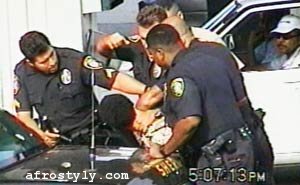
The month before I moved in, at a gas station just down the street, a man had videotaped a police officer beating up a teenage boy in handcuffs.

The videotape shows an officer picking up the boy from behind, who appears limp, and then slamming him against the hood of his patrol car.  He then turns the boy around and punches the boy in the face with a closed fist.

The boy was Donovan Jackson, a special-education student at the local high school.  He had been diagnosed with an auditory processing delay, which meant that it was difficult for him to follow verbal instructions.

Donovan had ridden to the gas station with his dad, then went inside the station to buy a bag of chips.   Police officer Carlos Lopez saw that the parked car's license plate tags were expired and approached Donovan's father, where he proceeded to find that his driver's license was suspended.  Officer Lopez was arresting Donovan's father when Donovan returned with his chips.  (Donovan's father, who was never accused of resisting, suffered injured ribs in the arrest.)

Officer Lopez yelled instructions at Donovan, who didn't respond and just stood in place looking at his father being arrested.  The officer finished arresting Donovan's dad and then attempted to force Donovan into the police car.  Officer Lopez claims that Donovan swung at him.  Two more officers arrived at this moment, having been called by Officer Lopez to provide backup to the arrest.  These officers, Jeremy Morse and Bijan Darvish, grabbed Donovan by the arms and forced him to the ground.  As he fell to the ground, Donovan, who was much smaller than the officers arresting him, flailed his arms, grabbing at Officer Morse's shirt and leaving a scratch on his face.  Officer Davish claims that Donovan also grabbed his uniform.  Officer Darvish then punched Donovan twice in the face.  Two more officers arrived at the scene (5 officers total now for a suspended licence!), one of them, Officer Antoine Crook, hitting Donovan with a flashlight in the process, and they handcuffed the teenager.  Donovan claims that the officers dragged him around the ground by the chain he wore on his neck, and that he was unable to breathe and nearly unconscious by the time he was handcuffed.

Several observers were screaming at the police to stop beating the teenager, which attracted a crowd.  One of them, Mitchell Crooks, heard the noise and grabbed a camcorder to began videotaping the beating he was observing.  At the start of the videotape, you can see Officer Morse pull the handcuffed Donovan up to his feet, who is not moving and appears limp, and then slam him face-first against the hood of his police car.


Officer Morse claims that at this point Donovan grabs his testicles, though that is not apparent on the video tape.  Officer Morse then held Donovan's neck with his left hand and punched Donovan in the face with his right hand.  He then appears to start choking Donovan, at which point the other officers intervene, one of them physically pulling Officer Morse off of Donovan.


It turned out that this was not an isolated incident.  A local woman claimed that Officer Morse had assaulted her earlier in the year.  The LA Times reported more than a dozen abuse-of-force incidents that the Inglewood Police Department had been involved in in recent years, often resulting in broken noses and teeth getting knocked out.  Many of the cases involved people who had not committed any crime, but were accused of police of "interfering with police business" or "contempt of cop".  Several of the people beaten by Inglewood police officers were local schoolteachers.

Officer Morse, who was videotaped slamming the handcuffed Donovan against the car and punching him in the face, was fired.

Officer Darvish, Morse's partner who later admitted punching Donovan in the face twice (not on tape), was suspended 10 days for filing a false incident report which failed to acknowledge any of the beating.  He continued to work as an officer in good standing with the Inglewood PD.

Officer Crook, who admitted hitting Donovan with a flashlight (not on tape), was suspended 4 days and lost his job as an officer, being reassigned as a civilian jailer.

Mitchell Crooks, the man who videotaped the incident, was tracked down by police and arrested a week later by officers on a 3-year-old warrant for misdemeanor DUI and hit-and-run.  Though he had previously been stopped by police several times for jaywalking and traffic violations, this was the first time that he was arrested, extradited back to Placer County, and forced to face charges.


When the courts got involved, it really got interesting.

Officer Morse, represented by elite lawyers who moved the trial to Torrance (a middle-class community miles from Inglewood) and whittled down the jury pool down to a single Black juror, managed to get a hung jury (7 in favor of conviction, 5 against) in his criminal trial.  Officer Morse was never convicted of any crime, despite the clear video evidence and testimony of other officers.  In a civil case, Officer Morse sued the City of Inglewood for firing him and claimed anti-White racial discrimination, because Officer Crook wasn't fired.  He won his lawsuit and was awarded $1.6 million.

Officer Darvish was found not guilty of filing a false report.  He also sued the city, like Officer Morse claiming that his 10-day suspension was the result of anti-White racial discrimination.  He also won and was awarded $810,000.  He still works as an officer.

Officer Crook and one other officer were granted immunity for their grand jury testimony against Officer Morse.

Donovan Jackson's family sued the City of Inglewood and the Inglewood PD in Federal Court for violations of Donovan's civil rights.  They settled out-of-court for an undisclosed amount.

Mitchell Crooks, the witness who videotaped the beating, served 7 months in jail for his arrest on the unrelated charges.

The City of Inglewood later sued its own lawyers for losing so many cases so badly.


This was the Inglewood neighborhood that I walked into.  From this high-profile case, citizens learned (or had confirmed), that:

* The police, who had been beating them for years, could continue to get away with it even if they got caught on videotape.

* Police officers are privileged enough that even when doing something wrong, they can still come out on top.

* Doing the right thing and going to the police with evidence might not be in your own best interest.

* The City of Inglewood is completely incompetent in all matters.


The problems with police brutality in Inglewood did not end.  In 2008, the LA Times published yet another report on excessive force by the Inglewood PD, including 11 lethal killings of citizens in 5 years, half of which were unarmed.  One especially egregious case involved a mentally ill man who repeatedly asked officers if he could pull up his slipping pants, then was shot and killed when he reached to pull them up.   Another involved a man shot in the back who had run away when officers stopped him for riding his bike on the sidewalk.  In 2010, the US Justice Department found significant flaws in how the Inglewood PD handled use-of-force incidents.  Unfortunately, excessive force in the Inglewood PD continues to this day.

Wednesday, April 22, 2015

Jaywalking for the police

I'm guessing that many people have noticed me talking about police-community relations during the past year.  (Though not on this blog.  Until now.)

This is not a new topic for me, but something that I've been thinking about for the last 15+ years.  So I wanted to share a few of my own experiences.

Growing up White, I didn't think particularly much about the police.  My grandfather was a California Highway Patrolman and later the chief of police of two small towns.  I had several friends whose fathers were cops.  But our town was rural and very quiet, and I never interacted with police officers in any official capacity.

In college I moved to a big city, learned more US History, and started to get a more diverse range of inputs on the impact that policing had on daily life for various communities.  At a Christian conference I attended during my senior year, I heard stories about the disproportionate manner in which Black people were often treated by police in comparison with White people.  But since very few people in my college were Black and most of my own police experiences were simply local cops coming to parties in response to noise complaints, I never got involved with anything myself.

This changed the summer after I graduated from college.  I started graduate school and my first professor was an African-American woman who had recently moved to town from a nearby city.  She was a Ph.D and an author, had been an award-winning teacher for many years, and was a professional in every sense.  In fact, I learned more about teaching from that first class with her than I did in all my later classes combined, and to this day I would say that she was my all-time favorite professor.  (I also took my final graduate school class with her.)  But she had one story that had nothing to do with teaching that stuck out to me.

About halfway through the summer, our professor came to class in a perturbed mood.  She complained that her son had just received his second jaywalking ticket since they had moved to town.  Both tickets had been given in "The Village", a heavy-commerce part of town with a walking culture, where cars moved slowly and people frequently crossed the street wherever they wanted.

That shocked me.  I had lived in this town for four years, and had never received a jaywalking ticket even though I jaywalked all the time.  I couldn't recall any of the other college students I knew receiving a jaywalking ticket.  But this 17-year-old Black teenager had already picked up two jaywalking tickets in his first couple of months?

There had been rumors that our mostly-White, middle-class college town had some racial animosity towards Black people.  A major police incident involving a young Black man had occured two years earlier, and there was an idea that racial animosity was particularly prevalent among city officials and the police.  There were strong suspicions of systematic racial profiling, but the local police department had refused to take racial statistics on officer stops.  Until now it hadn't affected anyone I knew.

So I decided to run a test.  I would purposely jaywalk across the biggest, busiest road in town at least 6 times every day for 6 months.  I would make a concerted effort to violate the jaywalking laws as often as possible, to see if a 21-year-old White man could possibly pick up the same tickets that a 17-year-old Black man had picked up.

I embarked on this experiment, not fearing the consequences, because I was almost certain that I already knew what would happen.

Sure enough, six months and approximately 1500 jaywalking incidents later, I was still ticketless.  I had jaywalked every day as often as I could without any policeman ever choosing to pull me over.  I'm not certain how many times a cop saw me jaywalk, but there were 7 incidents where I "illegally" stepped out onto the road directly in front of an officer's car.  In one incident the officer had to hit the brakes to avoid me.  Yet not once did any officer even stop to talk to me or give me a warning.  My jaywalking simply wasn't relevant to their police duties.

I reached the six month mark of my experiment confident that some laws didn't apply to me the same way they applied to other people.  It wasn't a perfect experiment.  I am certain that White people occasionally get ticketed for jaywalking in our community.  But it seemed too much of a coincidence that one of the very few Black men I knew would get 2 tickets within a couple months of moving into the community, while I couldn't get a ticket in 6 months no matter how hard I tried to keep violating the same rules in the most outlandish manner.  To this point in my life I have still never, ever been ticketed for jaywalking, despite the fact that I do a rather poor job of obeying the law in this regard.

The experiment stuck with me, and I as moved to a new community the next year, I experienced disparity in police treatment in a new environment.


Wednesday, July 09, 2014

Four news stories that make me sad

I was away for a few weeks, and am only slowly getting reintegrated back into life here.  So instead of talking about my community, I'm going to briefly mention four news articles that made me really sad this past few weeks:

Family-friendly tours of Bangkok's sex bars, with CNN doing their advertising for free

This article was written with a glibness that made me ill.
At another bar, both sons were lured on stage where two nude women spanked them with paddles made of harmless sponge, while the crowded bar's patrons roared with delight.
"My sons have absolutely come of age," marveled the 52-year-old father, Phil. "Because they're slightly reserved, the guys. Anything like this, they're not used to. They've grown up.


Leaked files show the Iraq War was even worse than we thought

There were already more than enough reasons to be against the Iraq War, including, of course, the lies that were told to lead us into it, the hundreds of thousands of people who were killed, the millions of people whose lives were traumatized, the enormous cost in broken lives to our own families, and the terrible state that the country was left in.  So it's just yet another depressing moment to find out that the US government was logging tens of thousands of civilian casualties while publicly claiming that they had no such logs.  The leaks also reveal that the government routinely ignored reports of rape, torture, abuse and murder, instead just passing the reports onto the very units responsible for the abuse.  In response to the report, the Pentagon only said that the leaks are terrible because they might give away US military tactics.  And then there's this:
The logs also illustrate the readiness of US forces to unleash lethal force. In one chilling incident they detail how an Apache helicopter gunship gunned down two men in February 2007.
The suspected insurgents had been trying to surrender but a lawyer back at base told the pilots: "You cannot surrender to an aircraft." The Apache, callsign Crazyhorse 18, was the same unit and helicopter based at Camp Taji outside Baghdad that later that year, in July, mistakenly killed two Reuters employees and wounded two children in the streets of Baghdad.

And another thing about that war

It looks like the mercenaries (I mean, "heavily armed civilian contractors who shoot people") we hired for that same war were more out of control than was ever let on to the public.
Just weeks before Blackwater guards fatally shot 17 civilians at Baghdad’s Nisour Square in 2007, the State Department began investigating the security contractor’s operations in Iraq. But the inquiry was abandoned after Blackwater’s top manager there issued a threat: “that he could kill” the government’s chief investigator and “no one could or would do anything about it as we were in Iraq,” according to department reports.

May God avenge their blood...but just case he doesn't, we already have

And, because the world constantly forgets how horribly war always goes for everyone involved, it looks quite possible that another one is about to start.  Three Jewish youths are tragically murdered, so a Muslim youth is gruesomely tortured and murdered in response, and the violence appears to continue to escalate.  Netanyahu, taking every opportunity to villainize and dehumanize the other side, claims:
"They sanctify death, we sanctify life.  They sanctify cruelty, and we mercy and compassion. That is the secret of our strength."
As he said that, hundreds of Palestinians were being arrested, 12 had been killed, Israeli soldiers had been filmed viciously beating Palestinian youth, and dozens of homes and businesses had been destroyed (this is in addition to the 25 Palestinians killed and hundreds injured in the partially related fighting in Gaza).  This is a repeat of the pattern that has existed since 2006, where 10-20 Palestinians are killed for every Israeli who is killed.  And, of course, Palestinian terror groups have been firing rockets as Israel in response.  Can neither side see that their violence only leads to more violence?  Or are they actually looking for violence, and are glad when their enemies respond just the way they want them too?


May the God of Peace turn our hearts to the peace that his son preached, and lead us to a different way of living in this world.

Friday, May 09, 2014

Thoughts on Egypt, Part II

In 2011, I gave my thoughts on the crisis of government in Egypt, and how I felt the Coptic community could best respond. I predicted that there would not be a governmental solution, but that the key to everything for the Christian community lay in our own conduct towards others and our obedience to God's call for our lives, most specifically in the love of our enemies and our solidarity with those who suffer at the hands of others. I laid out a few ways in which I felt God's call to His people applied in this case.

Last year, in the midst of horrifying persecution of Muslim radicals by the military government and horrifying persecution of Coptic Christians by the Muslim radicals, I wrote a hypothetical news story detailing what I felt a Christian response would look like in such a bad situation. My fictional story assumed not only consistent brave and sacrificial Christ-like love in action, but a history of such behavior over the decades. That story became one of the most-read things I ever posted. Unfortunately, the fictional nature of the story was missed by some, and the article was posted on twitter and re-tweeted by a number of people as an actual news story. Sadly, the specific actions of love and solidarity, and especially the language used, was not taken up by the church at large, and to this day Egyptians in general still believe that the church stood behind the military during the transition, rather than standing alongside the victims of violence on both sides.

This year we are back to square one. Once again we have a military (some would say fascist) government in total control of all aspects of power, and looking to cement its authority by imprisoning and/or killing all elements of the opposition by the thousands and tens of thousands. (And, for what it's worth, by trampling on all rights to free speech, free press, free assembly, free elections, and fair trials.) Once again we have a large segment of the Muslim population who is violently angry. And once again we have a Coptic population that is largely viewed as siding with the dictator in charge because they believes that violent power, however unjustly wielded, is the only thing that can protect them. It's just like Mubarak was back again, only more so.


As I say, this cannot end well.

As long as this branch of fundamentalist Muslims believe that the solutions to their problems are found in violence, they will bring more violence upon themselves. They die in suicide bombings and riots. They kill others in these bombings and riots. And they ensure that the government response to their violence will be even greater violence; that members of their own community, including thousands that didn't even participate in violence themselves, will be killed or imprisoned by a government that is willing to use the same violent tactics. No matter their rights to elected office or their appeal to the unjust nature of the government rampage, it must be said that a great deal of blame lies within the violent elements of their own movement.

As long as the military/government believes that violence is the means of control, it will continue to ensure a violent response from the population it governs. This government has run over people with their tanks, shot them with their guns, and threatened execution by the hundreds. It is an open secret that Egyptian prisons are warehouses of torture, and that this torture is condoned at the highest levels of government. Not only Muslim radicals, but foreign journalists, democracy activists, and unfortunate young men just pulled off the street have been imprisoned and tortured by a military bent on bloodshed. If the military says, “We can do whatever we want because we have the most power and we use the greatest violence”, then aren't they encouraging their opposition to do all they can to match that violence? As long as the government says that violence is the appropriate tool, then the government will be to blame for all the violence it sees, both the violence it inflicts and the violence inflicted upon it in response.

As long as the Christians of Egypt believe that their salvation lies in those who inflict violence, then they bear responsibility for the violence and bloodshed alongside those who are inflicting it. We are told not to rely on the might of Pharaoh's army, but in the strength of God's promise. We are told that those who live by the sword will die by the sword. We are told to never seek vengeance, to feed and care for our enemies, to turn the other cheek, and to visit those who are in prison. That is our response to a violent world who does not know the saving love of the One who died rather than respond to violence in kind. We are to stand with Jesus, the one who stood against both the violent Roman government AND the violent tendencies of the population who wanted to rebel against that government. We are to love the least, both theirs and ours; to take care of widows and orphans, both theirs and ours; to speak out for those who are not being spoken for, both theirs and ours. As long as we're failing to do those practical acts of love, as long as we're responding to those who hate us with hate-filled words, and as long as we're supporting the violent enemies of our enemies out of fear of man, then we are to blame for the hate and the violence that comes back to us in turn.

I do not believe that this is easy. It goes against the ways of the world. It involves self-sacrifice, and potentially suffering. I only believe it is possible because of what I've seen Christ do in the hearts of those who follow Him.  But in the long run this narrow path will be easier on our souls, and better for our lives, than responding the way the world responds.

We do not know how long this government will stand. Perhaps General Sisi, like Mubarak, will hold the reigns of power for decades. Perhaps, like Morsi, he will fall in a year. But what we do know is that he will not stand forever. And what happens when he does fall, and in all the time before then, depends partially on us. How can we blame those who do not know our Messiah, when we know him and yet act as we do?

Love your enemies, do good to those who hate you, bless those who persecute you, and pray for those who spitefully use you.

If your enemy hungers, feed him; if he thirsts, give him a drink

Pure and undefiled religion before God and the Father is this: to visit orphans and widows in their distress,and to keep oneself unspotted from the world.

Do not be overcome by evil, but overcome evil with good.

Not returning evil for evil, or reviling for reviling, but on the contrary blessing.


When the people of Egypt choose their next government (whether that choice is made at a ballot box or at the point of a gun), will they know the Copts as those who love them? Will they know the Copts as those who stood with them in their time of suffering? Will they know the Coptic Church as the ones who fought for their fair trials in the courts, who supported their women and children when the men were killed or imprisoned or disappeared, who provided sanctuary for them when they were being unjustly hunted down, who loved them even when they were not being loved back? Will they know that we have been blessing them? Will they believe that we have been praying for them?

Will they?

Every day counts.  Worldview perceptions do not change overnight.  We need to plant more seeds, and water them abundantly.

Wednesday, January 23, 2013

Looking them in the eye


I'm sitting on my mattress writing an essay about child laborers. Three feet in front of me, an actual child laborer is coloring pictures on a piece of paper, likely her best intellectual stimulation in days. To my left, her little brother is hammering away at Rose's purse, fixing a strap that's been broken for months. He fixed the zipper on my laptop cover before that. In both instances we didn't ask him to do it, but he's in our room a lot and just noticed things that needed fixing.

We're taking advantage of the job skills of a 9-year-old child laborer.  He and his sister work at home making purses instead of going to school.  Is it a bad thing that we let him fix our things today, getting an advantage from skills that he learned in place of learning to read?  Or is it a good thing because we're giving him a chance to feel important and serve us in some way, making our relationship more even? Should we pay him for what he's doing? Or is it better to keep a give-and-take as part of our friendship, where we share our food and buy him notebooks and pencils to draw and color with, and he fixes our zippers and purse straps?

These are the questions we ask ourselves. I can buy breakfast from 13 and 14-year-old sisters who roll out pooris. Dinner could come from a 15-year-old who has been working all day to prepare fish for her mom's restaurant. I pass doors where young boys who should be in elementary school are weaving rugs and melting on shoe soles. Nearly every corner store will be manned by a preteen for at least part of the day. The garbage on the streets will be picked up by kids as young as three, to later be sorted for recyclables by kids of every age. And professional beggers start almost from birth, as infants are loaned to begging women to elicit sympathy until the kids are old enough to walk around and pull on shirts with pleading eyes.

Figuring out appropriate responses to child labor are some of the “big” questions we find ourselves dealing with here. Whether to give to a begging child, whether to buy clothes in part made by a 12-year-old, and what to say to parents who are barely surviving even with the help of their working children are difficult scenarios to work out answers to. But I'm glad that we can be asking those questions in a context where those who face the consequences of our choices are right in front of us. In much of the rest of the world, millions of people every day are buying cell phones assembled in Chinese factories, eating chocolates or coffee made with cocoa and coffee beans from African farms, buying clothes and toys produced in Southeast Asian sweatshops (made from cotton grown in central Asia), eating beef, sugar, and tobacco made on South American plantations, wearing jewelry with gold and diamonds from African mines, and in general taking advantage of cheap child labor across the world, without ever meeting one of the kids who helped get that product to them at such a cheap price.

Monday, October 24, 2011

Who are we occupying?

A week ago I visited the "Occupy Vancouver" protests, our local offshoot of "Occupy Wall Street". There was a mishmash of every cause you can imagine, which is typical of Vancouver protests. But despite the signs calling for 9/11 truth, a ban on psychoactive drugs for children, and the legalization of raw milk, there was a strong trend of dissatisfaction with the financial system, especially the "1%" at the top who are benefiting most. Though I stayed for some time, I didn't participate with the protests, mostly because I didn't see a coherent enough message to affirm that I agreed. But much of what they say is valid. Here are my main thoughts:

  • That "1%" that everyone talks about do live in different reality. For example, most of us are still experiencing the worst economic downturn since the Great Depression. However, the number of millionaires increased to 10.9 million last year, the greatest number in history and almost 10% more than the 10.1 million millionaires we had before the recession hit. A third of those millionaires are in North America. The sales of luxury goods are projected to increase 13% this year, to their highest levels in history, with the USA the leading consumer. Meanwhile, unemployment is still over 8%, the number of uninsured Americans is at 50 million, and the average wage in America is the same as it was back in 1997.
  • This situation is not sustainable. In fact, it is going to blow up in our faces if something significant doesn't change. There's a lot more I could say about that.
  • Unfortunately, many of the protesters haven't realized that they are a part of the problem. How many of the 99% wanted to be as rich as the 1%? How many are greedy for more?  How many seek after material possessions? How many want to climb the corporate ladder? How many have used their credit cards for non-essentials they couldn't afford, bought homes with payments they couldn't make, or spent money on cars, accessories, entertainment, and other status symbols that they didn't need? As this Christianity Today article states, much of the blame lies in our own hearts and in our own decisions, and until those things change, it won't really matter what happens to the people at the top.
  • Finally, who are the 1% anyway? American protesters have focused on the top "1%", which in America basically means the millionaires. But do those same protesters realize that globally, most of them are much closer to the top 1% than they are to most of the other 99%? The very rough figures on the Global Rich List show anyone earning over $48,000/year in the top 1% of income earners. Are you protesting as part of the masses, when you are really the top 1% or 5% or 10% that the rest of the world is looking at and judging? Americans use over 30% of the world's energy and mineral resources, despite being only 5% of the world's population. What do you think the rest of the world thinks about you?


I think the protesters have an important point about the disparity of wealth and lack of justice in our society. I also think all of us, including myself and everyone reading this blog, have to realize how much we contribute to it. A couple months ago one of my best friends commented that she wanted to see more practical advice from me on what kinds of steps all of us can take towards more justice and Christ-like equality in society. I think I'm going to start doing that this week, because I think there's a lot that all of us could be doing, and I'd like to be doing it more intentionally. The world knows there's a problem with how things are going, and I want them to be able to look at Christians and see that there is a different way.

Sunday, October 16, 2011

About the “let him die?” video

Questioning at a recent Republican debate in Texas:


Under current health care law (instituted under Reagan), emergency rooms have to treat anyone who comes through their doors, regardless of whether they have insurance or not. If they don’t pay, the cost is passed on to those who do pay. Under the new health care law passed in 2010, everyone has to buy insurance (subsidized for those who can’t afford it) or pay a fine, thereby ensuring that everyone is fiscally responsible for their own medical care to the degree they are able, while still making sure that everyone can be treated.

In recent debates, it has become apparent that many Republicans and Libertarians, especially some of those failing under the “Tea Party” umbrella, would prefer a third option: that no one has to get any insurance ahead of time, and that anyone who doesn’t have insurance or cash when they need medical care is out of luck. In the moderator’s example from the debate, if such a person faces unpayable costs, some such participants think we should just “let him die”.

The way I understood this issue developed dramatically for me when I realized that the man in the moderator’s example isn’t the person we would “let die”. This man in the example has a high-paying job, which makes it likely that he has wealthy coworkers and wealthy friends. He likely has a network of family support and the same access to resources that the majority of privileged Americans have. If a life-or-death situation occurs, no one is going to “let him die” – someone is going to step up to help him get the care that he needs. Chances are that a change in the law will not drastically affect him.

So who will it affect?

The alien, the orphan, and the widow. The immigrant, the foster child, the single mother, and all others like them. The ones who are not only most likely to be poor, but least likely to have the social network to support them when unpayable expenses rear their head. When we say that we want everyone to pull their own weight, when we say that the government system for health care costs should be eliminated in favor of social and church networks, it is the widow, the orphan, and the alien who are going to be the hardest hit.

We need to think really, really seriously about what God has to say to us about that.

Friday, October 07, 2011

Who are the aliens, orphans, and widows in our midst?

When I hear “aliens, orphans, and widows”, my mind goes back to the Biblical era, or to non-Western nations in which orphanages are still prevalent or widows still can’t get their own source of income. But in the past two weeks I’ve realized that that historical displacement is unjustified.

In the United States, where are the orphans today? They are foster kids, those who grow up outside of the care of legally committed parents. Many of them spend their time in group homes or with unsympathetic families and are cast off at the age of 18 without any support network or stability. Some of them have moved from home to home and community to community so often that they don’t have any long-term relationships at all. What would it be like to be a young adult without a mother and father, aunts and uncles, or any long-term friends in your life? And that doesn’t even address the emotional, psychological, and educational problems that may have built up during their childhood and adolescence.

Who are the widows? They are single mothers who find all available energy taken up in playing both parental roles and having to be the family’s breadwinner besides. They lack the positive relational role a spouse could provide, the social connections the husband’s family could provide, and the social connections they could have developed in the free time they don’t have. Because of their family commitments they often lack college or high school education and can’t afford the time to get the additional work training they would need to advance at their jobs. And in the worst case scenarios, they are ostracized by churches, community organizations, or neighbors due to their marginalized status, or they self-ostracize because of the status they perceive themselves to have.

Who are the aliens? They are…the aliens, the immigrants, the refugees. They are the families who come alone to a new place because of war, persecution, or economic distress. They are the men who come alone, needing to find a job to support their families back home or fleeing situations back in their home countries that make a new land more appealing. Some of them are able to maintain long-distance relationships with friends and families in their home country; many others are in situations where such relationships are impossible. And so they have to make due in a new place, potentially with a new language, trying to navigate all the life obstacles that many of the rest of us have difficulty navigating, only they don’t have the entire framework of social support and cultural understandings that we build our lives upon.

God desires for us to direct our hearts to all those who are relationally vulnerable. A single mother doesn’t have to be an actual widow to warrent special concern in God’s eyes. Besides the foster kids, single mothers, and immigrants, there are millions of veterans, homeless persons, disabled persons, mentally ill persons, aboriginal peoples, and ethnically marginalized peoples that fit this description. Jesus is an advocate for all of us. But, as I tried to show in the last post, He is especially an advocate for those on the margins of society. We need to take this seriously, because God is calling us to advocate for the ones that the rest of society is ignoring, and if we fail to show mercy on them than God may pull back his mercy from us (Matthew 18:23-35).

Thursday, October 06, 2011

The alien, the orphan, and the widow

In the Bible, God shows a particular concern for those that society is less concerned about. While there are many individual examples of such concern, the marginalized are often represented by three terms, “the alien, the orphan, and the widow”. For example:

When you reap your harvest in your field and have forgotten a sheaf in the field, you shall not go back to get it; it shall be for the alien, for the orphan, and for the widow, in order that the LORD your God may bless you in all the work of your hands. When you beat your olive tree, you shall not go over the boughs again; it shall be for the alien, for the orphan, and for the widow. When you gather the grapes of your vineyard, you shall not go over it again; it shall be for the alien, for the orphan, and for the widow. - Deuteronomy 24:19-21

When you have finished paying all the tithe of your increase in the third year, the year of tithing, then you shall give it to the Levite, to the stranger, to the orphan and to the widow, that they may eat in your towns and be satisfied. - Deuteronomy 26:12

The LORD protects the strangers; He supports the fatherless and the widow, but He thwarts the way of the wicked. – Psalm 146:9

“Then I will draw near to you for judgment; and I will be a swift witness against the sorcerers and against the adulterers and against those who swear falsely, and against those who oppress the wage earner in his wages, the widow and the orphan, and those who turn aside the alien and do not fear Me," says the LORD of hosts. – Malachi 3:5

The special attention that must be paid to this trifecta is also mentioned in Exodus 22, Leviticus 23, Deuteronomy 10, 14, 16, 24 (again), and 27; Psalm 94, Jeremiah 7 and 22, Ezekiel 22, and Zechariah 7; and at least one member of the group is also highlighted sympathetically in Leviticus 19, Isaiah 1 and 10, Job 22 and 24; Psalm 68, Matthew 23, Luke 12, Mark 20, Acts 6, 1 Timothy 5, and James 1. Of course, there are hundreds of other passages that would also apply to these persons in the context of the poor, the needy, the marginalized, or our neighbors, but do not mention them explicitly.

The explicit mentions of these three groups is interesting to me because of the nature of their need. It’s not like “the hungry”, or “the naked”, or “the homeless”, or “the imprisoned”, who are defined by what they lack physically (food, clothing, shelter, or freedom). Instead, these groups are named because of a relational vulnerability, which increases their likelihood to lack in other things as well. Because of this vulnerability, God is especially concerned with these groups, and He judges his people when they fail to show such concern as well.

Does this mean that God likes orphans, aliens, and widows more than the rest of us? I don’t believe so – I don’t think God is biased in that way, and I think He loves all of us intensely. But I heard a good analogy last week that put things into perspective for me.

Imagine that you have three children – ages 7, 8, and 9. One day, the 7-year-old comes home with a broken nose, and you find out that she was beaten up by bullies at school. What would you do if you found out that such bullying had been happening every week, and that no one at the school had been doing anything about it? Would you then go to the school to advocate on that child’s behalf? Would you go to much greater lengths than normal to make sure that child was safe? Would you tell your other two children that they needed to be on the lookout to stand up for their little sister and protect her from those who were hurting her?

All that extra effort and attention doesn’t mean that you love your 7-year-old more. You just recognize that she is getting hurt more than the others, and that she needs special concern due to her situation. Because the rest of the world has treated your 7-year-old with less concern, you treat her more concern, and you call on your other children to give her special concern as well. If they refuse to make the extra effort for her, you will have very choice words for them.

God is the same way.

Saturday, August 06, 2011

Prophet of Doom

We can’t keep going on with business as usual like everything will be okay.

I watched television Friday morning, getting a rare glimpse of the news. The news programs were awash in stories of stock market collapse – starting in the United States and spreading across Asia. The causes of the market worries were employment and recession concerns exacerbated by the American political fight over debt. And the talk was about how and when it was going to be fixed - when the economy was going to start booming again and how the stock markets were going to start trending up again.

What if those aren't the solutions we need?

Consider the following:


1) Our economic health is dependent on constant growth. When the economy fails to grow, we declare a “recession” and worry abounds. Even low-level growth is considered insufficient – one major Republican presidential candidate recently proclaimed that his goal was 5% annual economic growth – a rate that would lead to the economy doubling in size every 14 years.

2) As the economy grows, the rich capture an ever-larger slice of the total. In America, the take-home income of the richest 0.1-0.01% of the population has increased 3-5 times over what it was in 1980, while the take-home income of the poorest 60% of the population hasn’t grown at all. Worldwide, the wealthiest 1% now control over 40% of the world’s wealth, and their portion is increasing every year.

3) We are getting fewer jobs out of our economic growth. Corporations are increasing efficiency and reducing labor costs, thereby allowing more things to be provided with fewer employees, ensuring the greatest profits for upper-level management and shareholders. As a result, economic growth no longer results in a comparable increase in jobs, though economic recession is still used as a reason to significantly reduce jobs.

4) Per American, our country is consuming about six times as many resources as we did in the 1950s and 50-200 times the resources that the residents of our own era's poorest nations consume. Despite the greatly increased consumption, Americans aren’t any happier than they were in the ‘50s. Yet the vast majority of Americans continue to make it their goal to consume more. For every family willing to move into a smaller house, get rid of their cars, and eat simpler food, there are ten families at every economic level who are trying to climb the economic ladder and consume more and more.

5) The world does not have enough space or resources to support this. If the whole world were to reach American standards in the next few decades, we would be using forty times as many resources as we are today. And we’re going to run out of resources (many mined metals, fossil fuels, sustainable fisheries, forested land, clean water, agricultural space, etc.) at the current pace, let alone a pace 40 times greater! It would take the land space of three Earths to sustain an all-American world even if we didn’t leave anything for the natural world, and the nonrenewable resources would still run out. The issues of land, water, energy, pollution, fossil fuel availability, mining, fisheries, deforestation, global warming, etc. are coming from so many different directions that no number of technological breakthroughs will solve all of them without a significant change in lifestyle.

6) The mechanisms of capitalism ensure that without significant outside interference, every one of these trends will continue. Capitalist economies will demand more growth, the rich will be better positioned to gain from that growth than the poor, and economic efficiency will trend towards fewer and fewer jobs for the same amount of growth. These economies will keep consuming more and more resources with fewer and fewer people benefitting from the gains until the whole thing collapses.


Where are we going with this? As individuals, are we going to keep consuming more and more at the expense of others, not to mention future generations? As voters and opinion-makes, will we let every American election hinge on whether or not the economy continues to grow fast enough to satisfy the rich and middle-class? As Americans, will we keep consuming far more than everyone else and keep promoting our consumption model across the world as the goal for all others to follow? Are we ready for where this is all going to lead, and do we understand who is going to suffer the most when it all comes apart?

This is only a small summary of one aspect of the rationales that are coalescing for me right now. There is much more from the Bible, historical and modern Christian teachings, political concerns, economic concerns, environmental concerns, and what I’ve seen over the last few years in America’s media, Bangkok’s commercialism, and India’s slums that convince me that we are seriously on the wrong track. It would take many hours to summarize all the things that are bothering me about this, but a great number of the issues involved could be covered with a careful reading of Collapse by Jared Diamond, Mustard Seed vs. McWorld by Tom Sine, and Rich Christians in an Age of Hunger by Ronald Sider. I don’t agree with everything in all three of those books, but together they cover the practical message of the unsustainability of the path we are on and the Godly directive of the path we should be on instead. Some of the numbers I mention here came from those books, as well as Unequal Democracy by Larry M. Bartels. The first three books also begin to deal with some of the things we could start doing to get on the right path, and I would strongly recommend Freedom of Simplicity by Richard Foster, Making Room by Christine Sine, and The New Monasticism by Jonathan Wilson-Hartgrove to keep developing more ideas.

Friday, February 18, 2011

Thoughts on Egypt

During the protests in Egypt I did not express an opinion on whether Christians should participate. And now that the protesters have succeeded, I still don't know. Mubarak was a dictator who imprisoned, tortured, or killed thousands of his political opponents, stole billions of dollars while many of his people suffered in poverty, and ruled a government that was full of corruption. But does that mean Christians are obligated to attempt to overthrow such dictators? And by what means? Does it matter that the alternative to Mubarak may be even worse? I don't know. So I couldn't say that Christians "should" work to overthrow him. But as I have prayed and reflected on the present, past, and future in Egypt, there have been a few things that I do feel I can state with confidence.


First, I believe that as Christians we cannot support what Mubarak did or trust him to "protect us". Some Christians told me that while Mubarak was bad, "at least he kept the Islamists in check", and "the alternative will be even worse".

I do not know whether the alternative will be worse. But no alternative can justify throwing our support behind a dictator who steals from the poor, imprisons tens of thousands of his political opponents, and uses torture and murder as weapons to control his people. What good would it do us to save our lives in such a manner, if we lose our souls in the process? What message would that give the world about who Christ is and what He would be in favor of? Better to lose our life to persecution and thereby save our souls than to preserve our lives through the support of such evil.


For those who wish to turn to Egypt's dictator for safety, I think the words of Isaiah 30 and 31 resonate today. The context is similar - the Jewish king was so afraid of the Assyrians and what they would do to Israel that he was willing to turn to the ruler of Egypt for protection. God's response through Isaiah is summarized in the first three verses of chapter 31:

Woe to those who go down to Egypt for help,
who rely on horses,
who trust in the multitude of their chariots and in the great strength of their horsemen,
but do not look to the Holy One of Israel,
or seek help from the LORD.

Yet he too is wise and can bring disaster;
he does not take back his words.
He will rise up against that wicked nation,
against those who help evildoers.

But the Egyptians are mere mortals and not God;
their horses are flesh and not spirit.
When the LORD stretches out his hand,
those who help will stumble,
those who are helped will fall;
all will perish together. Isaiah 31:1-3

We are to trust in God for protection, not Earthly rulers who are using unjust means.


My second thought deals with persecution. Persecution is painful, difficult. We need to support and pray for those who are persecuted, and publicly speak up to their persecutors in defense of their lives. But sometimes we may get so caught up in trying to avoid persecution that we forget - blessed are the persecuted!

Blessed are those who are persecuted because of righteousness, for theirs is the kingdom of heaven. Blessed are you when people insult you, persecute you and falsely say all kinds of evil against you because of me. Rejoice and be glad, because great is your reward in heaven, for in the same way they persecuted the prophets who were before you. - Matthew 5:10-12

Consider it pure joy, my brothers and sisters, whenever you face trials of many kinds, because you know that the testing of your faith produces perseverance. Let perseverance finish its work so that you may be mature and complete, not lacking anything...

Blessed is the one who perseveres under trial because, having stood the test, that person will receive the crown of life that the Lord has promised to those who love him. - James 1:2-4, 12

But before all this, they will seize you and persecute you. They will hand you over to synagogues and put you in prison, and you will be brought before kings and governors, and all on account of my name. And so you will bear testimony to me. But make up your mind not to worry beforehand how you will defend yourselves. For I will give you words and wisdom that none of your adversaries will be able to resist or contradict. You will be betrayed even by parents, brothers and sisters, relatives and friends, and they will put some of you to death. Everyone will hate you because of me. But not a hair of your head will perish. Stand firm, and you will win life. - Luke 21:12-19

Now I want you to know, brothers and sisters, that what has happened to me has actually served to advance the gospel. As a result, it has become clear throughout the whole palace guard and to everyone else that I am in chains for Christ. And because of my chains, most of the brothers and sisters have become confident in the Lord and dare all the more to proclaim the gospel without fear. - Philippians 1:12-14


There is much more - 1 Peter 3 and 4, 2 Corinthians 12:10, 2 Thessalonians 1:3-5, Acts 5:41, James 5:10-11. Far from being something that hurts believers, persecution strengthens faith and grows the church. The first few centuries of Christianity showed this abundantly. I do not believe that this means we need to seek out persecution. But when the choice is between facing persecution or supporting sin and injustice, then like the early martyrs we can embrace persecution with open arms.


Finally, I believe there is one clear proactive response to such situations. That response is embodied in the greatest commandments - Love the Lord your God, and Love your neighbor as yourself.

Imagine that there were two alternatives during Mubarak's thirty years in power. On the left, the church could have openly supported Mubarak's policies, been glad when he imprisoned and tortured those the church considered to be its enemies, done what it could to ensure that he stayed in power for as long as possible, and campaigned for someone just like him (such as his son) to take over when he died. Until that happened, we could have fervently prayed that Mubarak and his followers were able to stay in power and keep control over our enemies as long as possible.

And on the right, the church could instead have openly loved those that it considered to be its enemies. Millions of Christians could have actively worked day after day for those thirty years to show concrete acts of love to their neighbors. When people were unjustly imprisoned, the church could have spoken out on their behalf, even if they were part of the "enemy" faction. When torture, rape, or murder were sanctioned by the government, the church could have spoken out against it and stood with those who suffered, even if those suffering had hurt Christians in the past. And for thirty years, we could have fervently prayed for the souls of those who considered us their enemies, that through our love and the work of the Holy Spirit in their hearts they may come to have an eternal relationship with the true God.

Both choices would have had to face the truth that no human reign lasts forever, and that Mubarak or his successors were bound to one day fall. Until that happened, which strategy would have glorified God more? Which would have a greater chance of bringing an Egypt where Christians could live without "fear of man", but fear God alone? Which one was more likely to bring home the lost sheep that our Lord so deeply loves and wants to come into His fold? Which one shows more of God's love?

And, when Mubarak's reign finally did fall (as it did last week), which strategy would be more likely to have planted the seeds for a future Egypt where Christians are safe and respected as a part of the Egyptian community?

Mubarak's time is over. But Egypt's is not. These are not choices to be made in certain eras or by certain church leaders, but choices that every Christian has to make for herself every day and will still have to make no matter what government controls the nation. Do we trust in man to protect us from those we fear? Or do we make the choice to fear God alone, trust in God alone, and turn to our enemies with open arms and the love that Christ poured out to us when we were opposed to Him as well?


But I tell you who hear me: Love your enemies, do good to those who hate you, bless those who curse you, pray for those who mistreat you. - Luke 6:27-28

When we are cursed, we bless; when we are persecuted, we endure it. - 1 Corinthians 4:12

So do not be afraid of them, for there is nothing concealed that will not be disclosed, or hidden that will not be made known. What I tell you in the dark, speak in the daylight; what is whispered in your ear, proclaim from the roofs. Do not be afraid of those who kill the body but cannot kill the soul. Rather, be afraid of the One who can destroy both soul and body in hell. Are not two sparrows sold for a penny? Yet not one of them will fall to the ground outside your Father’s care. And even the very hairs of your head are all numbered. So don’t be afraid; you are worth more than many sparrows. - Matthew 10:26-31