Monday, May 11, 2015

Just a little too much

During the years I lived in Inglewood, I got little glimpses of the community-police dynamic.  It was not pretty.

One of the first memories of my time there was when I walked home from school to get lunch at my apartment.  While I was sitting at my computer eating a burrito, a major police action occurred across the street.  Apparently some robbers had ran from police and were in hiding.  The police surrounded the block, a guy with a shotgun standing every 40 feet or so.  I was amazed.  Police cars rolling around, guns being brandished everywhere, helicopters overhead.  I had never seen anything like it.

The shotguns looked like they were just being used as tools of intimidation.  Which, of course, they were.


Massive displays of force like that were common.  I had students tell me stories of their homes getting raided, police breaking down doors, charging in with guns drawn, scaring their family.  Sometimes it was the case of mistaken identity, or the police claimed they had the right home but failed to find anything in it.

Once it happened to me.  I went to my school on a Saturday, as I did every week, to water the class garden and take care of the classroom animals.  Since I only had my classroom key and not a front gate key, I jumped the gate like I did every week (which my principal was well aware of).  Except this week someone called the cops.

I didn't know anything was happening until I saw multiple police cars pull up into the school's back parking lot.  I thought, "Whoa, must be something big going on across the street."  Then I saw the police get out of their car and start gesturing towards me.  Wait, no, they were gesturing behind me.  I turned around and saw that multiple police cars had pulled into the front parking lot, and a gang of police officers had their guns drawn.

I walked over to them.

They asked me what I was doing.

I said that I was a teacher watering the plants.  I showed them the water can I was holding in my hand.

They put the guns away, apologized, blamed the caller, left.

(I should note that I got off a lot easier than the four Black parole officers who had guns pulled on them in a similar error.)

Our neighborhood was a scary place.  I knew multiple kids who got shot - it seemed to happen to someone at our school about once a year.  Once I drove down the street with one of my kids in the car, and he pointed out homes where friends of his had died, places where people he had known had been shot.  There was a shooting in front of our own house at least 4, possibly 5 times in the 4.5 years I lived there.

But I never saw how the dramatically violent police presence made the neighborhood safer, or reduced the likelihood that someone would die a violent death.  In fact, I think it made the neighborhood more dangerous.  And it wasn't just the people who were shot by Inglewood PD that I'm referring to here.  For everyone in Inglewood, the police were scary.  It made things tense.  It made people not want to call police in dangerous situations, not knowing what might happen.  And subconsciously it confirmed the belief that violence and force were the proper arbitrators of dispute, the go-to means of asserting one's own rights and power.

In America, I generally don't believe that we live in a "police state".  But some of our poorest neighborhoods are living in something close to one, and a lot of other neighborhoods have been moving in that direction in recent years.  Military gear, even armored vehicles, have been flowing into communities.  Images of police officers pointing sniper rifles at unarmed civilians or yelling threats at protesters, (even murderous ones) are the new normal.

Do neighborhoods with militarized police forces breed calmer, safer, more peace-loving citizens?  Does intimidation work as a technique for improving the life of a community?  I really doubt it.  But it appears to be the road that many community police forces have chosen to walk right now.  We only need to look at neighborhoods like Inglewood and others like it to see how well it's been working so far.

Friday, April 24, 2015

Beaten Community

The year after my jaywalking experiment, I moved to Inglewood to take a job teaching young people.  I entered a community that was riled up.

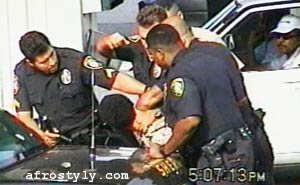
The month before I moved in, at a gas station just down the street, a man had videotaped a police officer beating up a teenage boy in handcuffs.

The videotape shows an officer picking up the boy from behind, who appears limp, and then slamming him against the hood of his patrol car.  He then turns the boy around and punches the boy in the face with a closed fist.

The boy was Donovan Jackson, a special-education student at the local high school.  He had been diagnosed with an auditory processing delay, which meant that it was difficult for him to follow verbal instructions.

Donovan had ridden to the gas station with his dad, then went inside the station to buy a bag of chips.   Police officer Carlos Lopez saw that the parked car's license plate tags were expired and approached Donovan's father, where he proceeded to find that his driver's license was suspended.  Officer Lopez was arresting Donovan's father when Donovan returned with his chips.  (Donovan's father, who was never accused of resisting, suffered injured ribs in the arrest.)

Officer Lopez yelled instructions at Donovan, who didn't respond and just stood in place looking at his father being arrested.  The officer finished arresting Donovan's dad and then attempted to force Donovan into the police car.  Officer Lopez claims that Donovan swung at him.  Two more officers arrived at this moment, having been called by Officer Lopez to provide backup to the arrest.  These officers, Jeremy Morse and Bijan Darvish, grabbed Donovan by the arms and forced him to the ground.  As he fell to the ground, Donovan, who was much smaller than the officers arresting him, flailed his arms, grabbing at Officer Morse's shirt and leaving a scratch on his face.  Officer Davish claims that Donovan also grabbed his uniform.  Officer Darvish then punched Donovan twice in the face.  Two more officers arrived at the scene (5 officers total now for a suspended licence!), one of them, Officer Antoine Crook, hitting Donovan with a flashlight in the process, and they handcuffed the teenager.  Donovan claims that the officers dragged him around the ground by the chain he wore on his neck, and that he was unable to breathe and nearly unconscious by the time he was handcuffed.

Several observers were screaming at the police to stop beating the teenager, which attracted a crowd.  One of them, Mitchell Crooks, heard the noise and grabbed a camcorder to began videotaping the beating he was observing.  At the start of the videotape, you can see Officer Morse pull the handcuffed Donovan up to his feet, who is not moving and appears limp, and then slam him face-first against the hood of his police car.


Officer Morse claims that at this point Donovan grabs his testicles, though that is not apparent on the video tape.  Officer Morse then held Donovan's neck with his left hand and punched Donovan in the face with his right hand.  He then appears to start choking Donovan, at which point the other officers intervene, one of them physically pulling Officer Morse off of Donovan.


It turned out that this was not an isolated incident.  A local woman claimed that Officer Morse had assaulted her earlier in the year.  The LA Times reported more than a dozen abuse-of-force incidents that the Inglewood Police Department had been involved in in recent years, often resulting in broken noses and teeth getting knocked out.  Many of the cases involved people who had not committed any crime, but were accused of police of "interfering with police business" or "contempt of cop".  Several of the people beaten by Inglewood police officers were local schoolteachers.

Officer Morse, who was videotaped slamming the handcuffed Donovan against the car and punching him in the face, was fired.

Officer Darvish, Morse's partner who later admitted punching Donovan in the face twice (not on tape), was suspended 10 days for filing a false incident report which failed to acknowledge any of the beating.  He continued to work as an officer in good standing with the Inglewood PD.

Officer Crook, who admitted hitting Donovan with a flashlight (not on tape), was suspended 4 days and lost his job as an officer, being reassigned as a civilian jailer.

Mitchell Crooks, the man who videotaped the incident, was tracked down by police and arrested a week later by officers on a 3-year-old warrant for misdemeanor DUI and hit-and-run.  Though he had previously been stopped by police several times for jaywalking and traffic violations, this was the first time that he was arrested, extradited back to Placer County, and forced to face charges.


When the courts got involved, it really got interesting.

Officer Morse, represented by elite lawyers who moved the trial to Torrance (a middle-class community miles from Inglewood) and whittled down the jury pool down to a single Black juror, managed to get a hung jury (7 in favor of conviction, 5 against) in his criminal trial.  Officer Morse was never convicted of any crime, despite the clear video evidence and testimony of other officers.  In a civil case, Officer Morse sued the City of Inglewood for firing him and claimed anti-White racial discrimination, because Officer Crook wasn't fired.  He won his lawsuit and was awarded $1.6 million.

Officer Darvish was found not guilty of filing a false report.  He also sued the city, like Officer Morse claiming that his 10-day suspension was the result of anti-White racial discrimination.  He also won and was awarded $810,000.  He still works as an officer.

Officer Crook and one other officer were granted immunity for their grand jury testimony against Officer Morse.

Donovan Jackson's family sued the City of Inglewood and the Inglewood PD in Federal Court for violations of Donovan's civil rights.  They settled out-of-court for an undisclosed amount.

Mitchell Crooks, the witness who videotaped the beating, served 7 months in jail for his arrest on the unrelated charges.

The City of Inglewood later sued its own lawyers for losing so many cases so badly.


This was the Inglewood neighborhood that I walked into.  From this high-profile case, citizens learned (or had confirmed), that:

* The police, who had been beating them for years, could continue to get away with it even if they got caught on videotape.

* Police officers are privileged enough that even when doing something wrong, they can still come out on top.

* Doing the right thing and going to the police with evidence might not be in your own best interest.

* The City of Inglewood is completely incompetent in all matters.


The problems with police brutality in Inglewood did not end.  In 2008, the LA Times published yet another report on excessive force by the Inglewood PD, including 11 lethal killings of citizens in 5 years, half of which were unarmed.  One especially egregious case involved a mentally ill man who repeatedly asked officers if he could pull up his slipping pants, then was shot and killed when he reached to pull them up.   Another involved a man shot in the back who had run away when officers stopped him for riding his bike on the sidewalk.  In 2010, the US Justice Department found significant flaws in how the Inglewood PD handled use-of-force incidents.  Unfortunately, excessive force in the Inglewood PD continues to this day.

Wednesday, April 22, 2015

Jaywalking for the police

I'm guessing that many people have noticed me talking about police-community relations during the past year.  (Though not on this blog.  Until now.)

This is not a new topic for me, but something that I've been thinking about for the last 15+ years.  So I wanted to share a few of my own experiences.

Growing up White, I didn't think particularly much about the police.  My grandfather was a California Highway Patrolman and later the chief of police of two small towns.  I had several friends whose fathers were cops.  But our town was rural and very quiet, and I never interacted with police officers in any official capacity.

In college I moved to a big city, learned more US History, and started to get a more diverse range of inputs on the impact that policing had on daily life for various communities.  At a Christian conference I attended during my senior year, I heard stories about the disproportionate manner in which Black people were often treated by police in comparison with White people.  But since very few people in my college were Black and most of my own police experiences were simply local cops coming to parties in response to noise complaints, I never got involved with anything myself.

This changed the summer after I graduated from college.  I started graduate school and my first professor was an African-American woman who had recently moved to town from a nearby city.  She was a Ph.D and an author, had been an award-winning teacher for many years, and was a professional in every sense.  In fact, I learned more about teaching from that first class with her than I did in all my later classes combined, and to this day I would say that she was my all-time favorite professor.  (I also took my final graduate school class with her.)  But she had one story that had nothing to do with teaching that stuck out to me.

About halfway through the summer, our professor came to class in a perturbed mood.  She complained that her son had just received his second jaywalking ticket since they had moved to town.  Both tickets had been given in "The Village", a heavy-commerce part of town with a walking culture, where cars moved slowly and people frequently crossed the street wherever they wanted.

That shocked me.  I had lived in this town for four years, and had never received a jaywalking ticket even though I jaywalked all the time.  I couldn't recall any of the other college students I knew receiving a jaywalking ticket.  But this 17-year-old Black teenager had already picked up two jaywalking tickets in his first couple of months?

There had been rumors that our mostly-White, middle-class college town had some racial animosity towards Black people.  A major police incident involving a young Black man had occured two years earlier, and there was an idea that racial animosity was particularly prevalent among city officials and the police.  There were strong suspicions of systematic racial profiling, but the local police department had refused to take racial statistics on officer stops.  Until now it hadn't affected anyone I knew.

So I decided to run a test.  I would purposely jaywalk across the biggest, busiest road in town at least 6 times every day for 6 months.  I would make a concerted effort to violate the jaywalking laws as often as possible, to see if a 21-year-old White man could possibly pick up the same tickets that a 17-year-old Black man had picked up.

I embarked on this experiment, not fearing the consequences, because I was almost certain that I already knew what would happen.

Sure enough, six months and approximately 1500 jaywalking incidents later, I was still ticketless.  I had jaywalked every day as often as I could without any policeman ever choosing to pull me over.  I'm not certain how many times a cop saw me jaywalk, but there were 7 incidents where I "illegally" stepped out onto the road directly in front of an officer's car.  In one incident the officer had to hit the brakes to avoid me.  Yet not once did any officer even stop to talk to me or give me a warning.  My jaywalking simply wasn't relevant to their police duties.

I reached the six month mark of my experiment confident that some laws didn't apply to me the same way they applied to other people.  It wasn't a perfect experiment.  I am certain that White people occasionally get ticketed for jaywalking in our community.  But it seemed too much of a coincidence that one of the very few Black men I knew would get 2 tickets within a couple months of moving into the community, while I couldn't get a ticket in 6 months no matter how hard I tried to keep violating the same rules in the most outlandish manner.  To this point in my life I have still never, ever been ticketed for jaywalking, despite the fact that I do a rather poor job of obeying the law in this regard.

The experiment stuck with me, and I as moved to a new community the next year, I experienced disparity in police treatment in a new environment.


Wednesday, October 22, 2014

What I do, What I have, What people say about me...is not who I am

A little clarification, with some caveats.


What exactly have you been doing there?

Primarily, I've been trying to learn the local languages, learn how to live daily life in the slum and be a good example to others as I do so, and teach illiterate children how to read in Hindi.  I'm also supporting my wife in her programs with women in the basti and teenage victims of human trafficking.  Here and there I've been non-violently intervening in fights between men and beatings of women and children, helping an over-achieving slum resident get into college and succeed there, and trying to be a good example of a man by doing household work, speaking appropriately about women, and defending the weak. Outside of the slum I've been serving on the board of a city-wide (soon to be international) literacy program and trying to help them improve the program, teaching Christians in the city and beyond about the kingdom of God, and trying to help people like me live here in the city. Internationally I'm supporting other people in living this same kind of life among the poor, promoting a more sustainable relationship between people and the environment, and lending assistance to scientific research in India, Bangladesh, and America.

But I am not what I do.


How do you live? Like, what do you have?

My wife and I rent an upstairs room from a large family in the slum. It's a little 8ft by 9ft brick room with a tarp and bamboo roof. A little water gets in through the sides but the roof doesn't leak at all. Our appliances are a gas stove, a ceramic water filter, a light bulb and a fan. We sleep on a foam mattress on the ground under a mosquito net. Our latrine is outside in the shared space with the family, but we are the ones who primarily use it when the next-door room is unoccupied (there's another latrine downstairs). We carry our water upstairs in buckets that we fill at a downstairs tap. Most of our other possessions are quite simple, but I do have a mobile phone, a camera, and a laptop. My wife also has a bicycle.

But I am not what I have.


What do the people say about you?

Initially some people were saying that maybe I was working for the CIA, or that I was a criminal on the run. (They didn't tell me that directly, but I found out through the grapevine.) Generally most people seem to have come to know that we are here to live with and serve among normal people, and they are respectful of that.  They share it enough that people I've never met before sometimes know my name and what I'm doing here.  Our primary mode is “guest”, and we are treated extremely hospitably by many many people. Some people consider us saints, or infidels, or crazy for having left a place like America. Some people have said that I must be pretty stupid because I can't speak Hindi correctly or even know how to do basic household work the right way. I think some people think that I'm a little shy, and others might think I'm lazy because I don't have a “normal” job yet, but I haven't heard people actually share that. At least one person says that I'm their best friend.

Outside of the slum, some people say that I'm a role model, a heretic, idealistic, unrealistic, a jerk, a hero, inappropriate, too negative a person, too optimistic a person, a confused liberal, a brainwashed conservative, impatient, loud, aggressive.

But I am not what people say about me.


So what am I then? At the most important core, I identify as a child of God and a disciple of Christ.

I am a child of God before I am anything else.

My personality at the root is that of an idealist (a “1” on the Enneagram if you like that sort of thing). I am a person in process, with a lot of faults and a long way to go. But a child of God, and already loved by God just the way I am.


No matter what I do, what I have, or what people say about me.


This post inspired by Henri Nouwen's following talk, and the fact that those three questions are the exact three questions that people from the outside always ask me about my life here.

Friday, August 29, 2014

12:42am

At times I wonder
if I die tomorrow
Would it have mattered that I was here?

Two years of faltering
trying
Bearing witness
coming up short

I returned from India in 2004
Watched Hotel Rwanda
Cried for two hours

Why did we do nothing!!@!@
They were dying
Slaughtered
Suffering

And we sat here, doing nothing

That moment the roots entwined with the bedrock

God had planted a seed six years earlier
a Mark 8 bible study and a word just for me
He watered it with every year of faith
Fed it in Inglewood
Pruned it into a vision in India
but it was that moment, watching that movie, that the roots grabbed bedrock that they could never let go

I will not sit here while they die there
even if all I can do is stand in front of a machete and say NO!
become one more life cut down
I will do it
in the hope that my life given, my “No” voiced, would inspire one more crack in the dam
one more witness
one more NO!
Because Jesus didn't stand in the gap, refuse to strike, love the other, impale on a cross
so we could sit here in a backed-up reservoir of “God's provision”
while billions suffer in a dried out desert below
begging for the scraps that fall off of our table.
[Face contorted. Sob into my mat. Choking on it]

I want.
To crack.
This dam.

I would die for that.

And when I set my hand to that plow
I never, ever thought of turning back.

But an outcome I never considered
What if
[Sobs again. Mouth open. Shoulders wracked. Get my head under the mat. Dont wake them up. Don't let them hear.]
What if I got here
stood in front of the machete
and its wielder, the true enemy, just smiled and passed me by
What if I didn't die?
and they still did.
The father. The uncle. The teenager. The neighbor. The baby.
and I did nothing
nothing that made a difference
And they still died.

I know that if I am faithful for ten years, it will make a difference
in a life. or a thousand. or ten
but what if I die tomorrow?
what if I don't get ten years?
do I know how long I have to watch them die around me?

my little crack in the dam
dries up before the water can even reach the ground
and no one looks to make any more cracks

This is reality
we are here

We are here.
God is Faithful.

We are here.
Come, Lord Jesus, come.

I might die tomorrow
and I know that's not the worst thing that can happen
because I already see worse now


The text read “baby died”
And there was nothing I could have done
nothing I could do

so tonight I cry

Wednesday, July 09, 2014

Four news stories that make me sad

I was away for a few weeks, and am only slowly getting reintegrated back into life here.  So instead of talking about my community, I'm going to briefly mention four news articles that made me really sad this past few weeks:

Family-friendly tours of Bangkok's sex bars, with CNN doing their advertising for free

This article was written with a glibness that made me ill.
At another bar, both sons were lured on stage where two nude women spanked them with paddles made of harmless sponge, while the crowded bar's patrons roared with delight.
"My sons have absolutely come of age," marveled the 52-year-old father, Phil. "Because they're slightly reserved, the guys. Anything like this, they're not used to. They've grown up.


Leaked files show the Iraq War was even worse than we thought

There were already more than enough reasons to be against the Iraq War, including, of course, the lies that were told to lead us into it, the hundreds of thousands of people who were killed, the millions of people whose lives were traumatized, the enormous cost in broken lives to our own families, and the terrible state that the country was left in.  So it's just yet another depressing moment to find out that the US government was logging tens of thousands of civilian casualties while publicly claiming that they had no such logs.  The leaks also reveal that the government routinely ignored reports of rape, torture, abuse and murder, instead just passing the reports onto the very units responsible for the abuse.  In response to the report, the Pentagon only said that the leaks are terrible because they might give away US military tactics.  And then there's this:
The logs also illustrate the readiness of US forces to unleash lethal force. In one chilling incident they detail how an Apache helicopter gunship gunned down two men in February 2007.
The suspected insurgents had been trying to surrender but a lawyer back at base told the pilots: "You cannot surrender to an aircraft." The Apache, callsign Crazyhorse 18, was the same unit and helicopter based at Camp Taji outside Baghdad that later that year, in July, mistakenly killed two Reuters employees and wounded two children in the streets of Baghdad.

And another thing about that war

It looks like the mercenaries (I mean, "heavily armed civilian contractors who shoot people") we hired for that same war were more out of control than was ever let on to the public.
Just weeks before Blackwater guards fatally shot 17 civilians at Baghdad’s Nisour Square in 2007, the State Department began investigating the security contractor’s operations in Iraq. But the inquiry was abandoned after Blackwater’s top manager there issued a threat: “that he could kill” the government’s chief investigator and “no one could or would do anything about it as we were in Iraq,” according to department reports.

May God avenge their blood...but just case he doesn't, we already have

And, because the world constantly forgets how horribly war always goes for everyone involved, it looks quite possible that another one is about to start.  Three Jewish youths are tragically murdered, so a Muslim youth is gruesomely tortured and murdered in response, and the violence appears to continue to escalate.  Netanyahu, taking every opportunity to villainize and dehumanize the other side, claims:
"They sanctify death, we sanctify life.  They sanctify cruelty, and we mercy and compassion. That is the secret of our strength."
As he said that, hundreds of Palestinians were being arrested, 12 had been killed, Israeli soldiers had been filmed viciously beating Palestinian youth, and dozens of homes and businesses had been destroyed (this is in addition to the 25 Palestinians killed and hundreds injured in the partially related fighting in Gaza).  This is a repeat of the pattern that has existed since 2006, where 10-20 Palestinians are killed for every Israeli who is killed.  And, of course, Palestinian terror groups have been firing rockets as Israel in response.  Can neither side see that their violence only leads to more violence?  Or are they actually looking for violence, and are glad when their enemies respond just the way they want them too?


May the God of Peace turn our hearts to the peace that his son preached, and lead us to a different way of living in this world.

Friday, May 30, 2014

Don't hit

I looked outside to see my 13-year-old neighbor beating on his 9-year-old sister, hitting her as hard as he could. I got upset at him, saying, “Don't hit! Stop hitting her, ever!” with a stern expression on my face.

“Don't hit?” he repeating quizzically with a half-grin. He was completely confused. I might as well have been saying, “Don't eat.” I turned and saw his mother behind me, who I had not realized was there. She looked just as confused.

I understand why. The mother is always hitting the children. The oldest son is always hitting his other siblings. The other children are always hitting each other. Violence is ingrained into them. The oldest boy even seems to take joy in it. When he's hitting one of his little sisters I get so mad I want to smack him across the face.

Wait.

Violence is ingrained into us.

I don't have to study sociology to understand why there is so much violence here. I can view the roots within my own heart. I can read it in the Bible from Genesis 3:5-8 to James 4:1-2. In case we think we come from a more civilized time, remember that the last century saw more people die in war than all previous centuries combined. In America we re-elected a president who makes up a list each week of people he wants to kill and before that a president who seemed to be listing countries he wanted to eliminate. Look at General Sisi's purge and its tens of millions of fans, or Putin's saber-waving and his hundreds of millions of fans. Read the internet comments under every story about an execution, drone attack, police shooting, serious crime, or Trayvon Martin. We are a blood-lustful people. And most of you reading this can understand why, because somewhere in your own heart you feel a capacity for violence as well.
If only it were all so simple!  If only there were evil people somewhere insidiously committing evil deeds, and it were necessary only to separate them from the rest of us and destroy them.  But the line dividing good and evil cuts through the heart of every human being.  And who is willing to destroy a piece of his own heart? - Aleksandr Solzhenitsyn
Jesus could not have been unaware of this the human tendency towards violent solutions. Judas handed him over to the executioner for 30 pieces of silver. Peter chopped the ear off of a man. James and John asked if they could destroy a village. The chief priests and elders spat in his face and beat him while sentencing him to die. The governor and his soldiers mocked him, lashed him, and nailed him to a cross. And the same crowds he spoke of love to shouted “crucify him!”

If Jesus was truly human, he may even have known the potential for this angry bloodlust in his own heart.

Yet he knew a way out.

The key was his recognition of the true enemy.

In Matthew 4:1-10, Jesus engages in an epic confrontation with the satan. Jesus defends himself not through violence, but through reliance on God. He rejects Satan's ways of false security, public glory, and worldly power (the ways of the world) in favor of meekness and trust in God. He exposed society's need to provide infinite goods for oneself (Matthew 4:3), the need to look amazing in the eyes of others (Matthew 4:5-6), and the need to wield control over others (Matthew 4:8-9). Jesus saw through these things and saw that the satan himself was the true enemy and defeated him. He released himself to fully love others and show them the way to God's kingdom. That way led to the cross, yet also to the resurrection. That way led to suffering, yet also to freedom. That way led away from the ways of the world and to true humanity.

Put aside the need to possess things.
Put aside the need to be praised by others.
Put aside the need to control others.
Love others with your full heart, knowing that the satan is the true enemy, not them.
Ask God to take your bloodlust and your violence away.
A bit at a time, let the Kingdom of God take possession in your heart.
In this, and only this, will we find victory.

And when you've glimpsed enough of this to begin to know what it means for yourself, personally, share what you've glimpsed with others, in love.

Only in this will the beatings ever stop.

Until then, pray for those who are beaten, raped, shot, injected, or bombed every day by those of us who are still learning to let God conquer our hearts. Messiah Jesus be with them.


Something Like Scales (Tom Wuest)

In our blindness, lead us down that road
In our ignorance, lead us down that road
In our violence, hate and indifference
We pray Lord you give us new sight

Let something like scales, fall from our eyes
Something like scales fall from our eyes
Jesus, lead us down that road
Lead us down that road

Wednesday, May 28, 2014

The Great Divide

I recently attended a talk in the fanciest-looking building in our city.

The speaker was someone I've recently been helping out with a project, and so she had me come up to share a bit. The audience consisted of a few dozen powerful businessmen. (Luckily, I had changed into the best clothes I own right before I came.) A videographer and three photographers rolled film while I spoke. The next day articles about the talk would appear in a dozen newspapers in three languages, with two or three of them mentioning “Mister John”.

After the talk I was pulled aside by half-a-dozen wealthy men in turn, all of whom wanted to ask me questions and exchange contact information. I finally got out of there almost three hours after the meeting began.

While others got into their chauffeured cars, I walked out of the building, crossed one street, ducked under the railroad tracks, and entered my slum, not 5 minutes from where I'd just hobnobbed with the rich and powerful. As I strolled through the alleys I felt like my clothes didn't attach to my body. There was a tangible electricity on my skin, as I thought, “Where was I? And now where am I? And what could all those who I was just talking to know about the lives that are lived right here?”  It felt like I had just escaped back into real life from something less than that.  Later that week I told my friends that it was the moment in the week that I felt the most alive.


America has used multinational corporations, the military, and remarkably unjust trade and aid laws in order to outsource its poverty to other countries where it doesn't have to look at it. But here, the incredibly rich and incredibly poor still live within sight of each other. And yet they feel almost as far apart.   

Saturday, May 24, 2014

The most surreal movie experience of my life

A chai-wala delivers drinks to working men.

A teenager cracks jokes with his uncle in an auto shop.

A shirtless boy tries to sell flowers on the streets.

A kid focuses on the embroidery he sets into place.

A ragpicker gets chased away from pieces of trash too close to the VIPs.

The scenes crawled across the screen. The camera lingered on boys trying to help their families (or just themselves) survive in the richest city in India, as wealthy businessmen and private school kids zipped by in the background. The empathy with which the children were depicted was stunning.


Last night I saw “Hawaa Hawaai”, a Bollywood movie about a child laborer from an Indian slum who pursues his dreams while trying to deal with serious illness and his father's death. I went to the movie together with my friend Mohammed...who for most of his life has been a child laborer from an Indian slum pursuing his dreams while trying to deal with serious illness and his father's death.

Neither of us knew what the movie was going to be about when we went to watch it, and we sort of picked it on a whim. Mohammed was treating me to the movie and not only bought my ticket, but insisted on getting me a cold drink.

It was a comfortable, nice movie theater. As I was moved by the film's scene-setting, it took conscious effort to focus on the fact that Mohammed wasn't just any friend laughing at the jokes, but someone who had lived much of it. I don't know what it meant for my experience watching the movie. If the characters in the movie had been portrayed unnaturally or offensively, I'm sure it would have meant something. But considering the compassion and empathy with which the characters were depicted...I was happy to be there with Mohammed, and that was that.

I asked him the next day if he liked the movie, and he said that he did. I asked him what he liked most about the movie. The assumed answer was going to be “the jokes”, since Mohammed had laughed so hard at a number of them. But instead, he answered, “His hard work.”


There's a bit of Bollywood in the movie, but it is very much worth watching.

Wednesday, May 21, 2014

Those Hindus

My 21-year-old Muslim friend came up to me and told me that he had two interactions from this morning to tell me about. In his words:

“This morning my brother told me that Hindus are bad people. I asked him, 'Who made Hindus?' God did! We are all children of God, so we cannot say that they are bad.”

“Then an aunti told me today, 'Don't eat the poori from the Hindus because they drink alcohol.' [That day was a Hindu festival and some Hindus were distributing free food.] I told her, 'Many Muslims in our basti drink too! Have you ever eaten in my home?' She said, 'Yes, twice.' So I told her, 'Well, I have drunk alcohol twice!'”


Yeast spreads slowly, and the early steps don't look like much. But eventually it permeates the whole dough.